
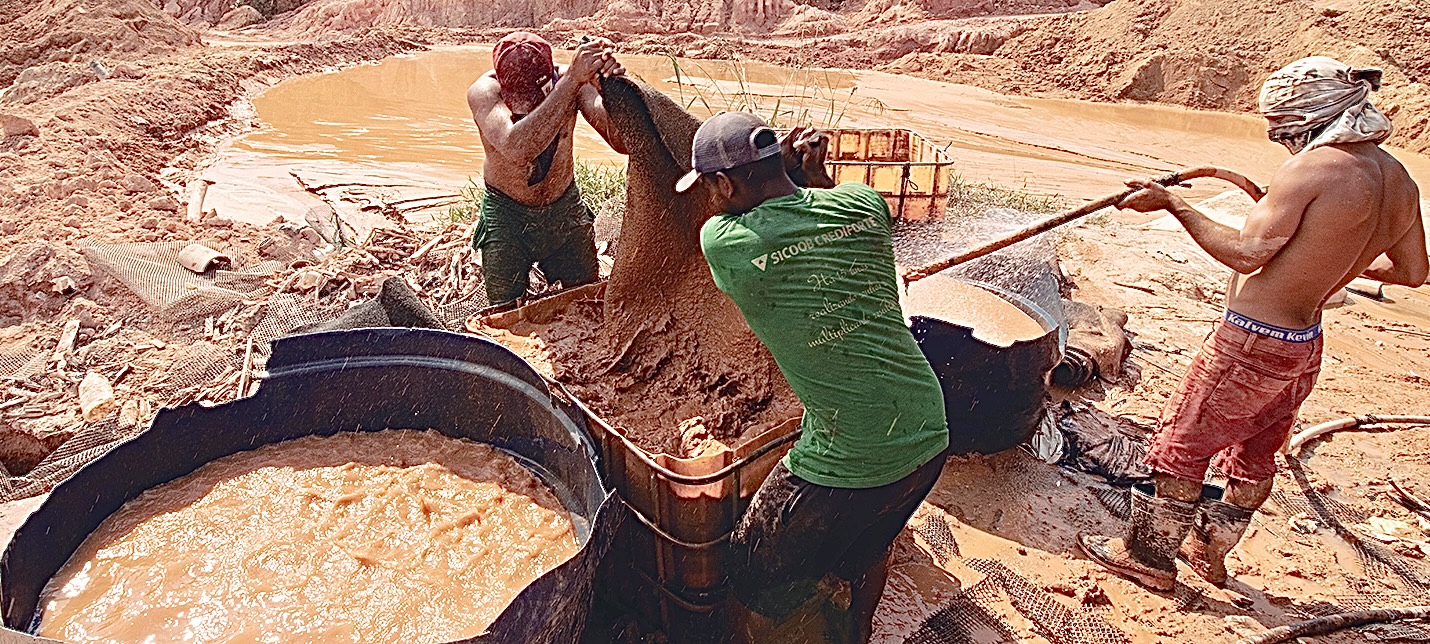
The Tapajós River runs 840 kilometers through the heart of the Brazilian Amazon, cutting through indigenous territories, national parks, poverty-stricken towns, and many of Brazil’s small-scale gold-mining sites—or garimpos, as they are called in Portuguese. In this environment, where gold mining is often illegal, garimpeiros (miners), both men and women, are subjected to poor and dangerous working conditions. As many as 40 % of all gold miners in the region may be victims of human trafficking for forced labor, according to a pioneering study conducted by the United Nations Office on Drugs and Crime (UNODC) in Brazil.
The mining footprint across the Amazon reached about 496,000 hectares between 2018 and 2025. Roughly 223000 hectares were in Brazil, much of it in areas where the activity carried a high risk of illegality. In November 2025, Brazilian authorities, with the support of Interpol, disabled 277 dredges used for illegal gold mining along the Madeira River. The machinery was valued at about $6.8 million.
Mercury poses the most immediate danger. Miners use it to bind small particles of gold into an amalgam. Mercury lost during processing enters the air and water, accumulates in fish and eventually reaches communities far from the mine itself.
Beyond the figures and Bamidbar, the miners’ lives reveal unique stories of internal migration, estrangement from family, debt bondage, health problems, and a persistent dream of striking gold. Sometimes the garimpo fails; there’s little gold, but the prospector continues to believe that it will get better. In remote and male-centered mining communities, women are also vulnerable to sexual exploitation in prostitution.
The Tapajos Project aims to determine the prevalence and drivers of human trafficking for forced labor in the gold mining sector in the Tapajos basin in Pará, Brazil, and to implement evidence-based interventions to reduce crime in the region. The project is being implemented by the UNODC office in Brazil, the Human Trafficking and Smuggling Section, and the Research and Trend Analysis Branch, and is funded by the Office to Monitor and Combat Trafficking in Persons of the Department of State of the United States of America.