
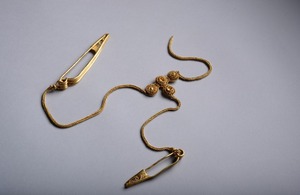
Export bar placed on Iron Age gold brooches to allow time for a UK institution to acquire them
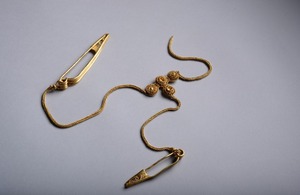
Arts and Heritage Minister Lord Parkinson of Whitley Bay has placed an export bar on a set of Iron Age gold brooches dating back to the first century BC, so that a domestic buyer can be found.
The brooches, valued at £260,000 (plus VAT of £52,000), are at risk of leaving the UK permanently.
They are a rare set of exceptionally preserved jewellery, consisting of two brooches and three chains connected by a pendant, made entirely from gold. The form of the two brooches and the style of gold working on the chain and pendant suggest they were made between 80–20 BC.
The brooches are similar to the Winchester Hoard, which was discovered in Hampshire in 2000 and is now on display at the British Museum. In both examples, the makers used pre-Roman Mediterranean craft techniques on object forms particular to France during the time of the Gallic wars and Roman invasions of southern Britain.
Arts & Heritage Minister Lord Parkinson of Whitley Bay said:
The minister’s decision follows the advice of the Reviewing Committee on the Export of Works of Art and Objects of Cultural Interest.
Committee Member Tim Pestell said:
The committee made its recommendation on the basis that the brooches met the second and third Waverley criteria for their outstanding significance for the study of goldwork and the Roman empire during the 1st century BC.
The decision on the export licence application for the brooches will be deferred for a period ending on 23 February 2024 (inclusive). At the end of the first deferral period owners will have a consideration period of 15 Business Days to consider any offer(s) to purchase the brooches at the recommended price of £260,000 (plus VAT of £52,000 which can be reclaimed by an eligible institution). The second deferral period will commence following the signing of an Option Agreement and will last for three months.
Offers from public bodies for less than the recommended price through the private treaty sale arrangements, where appropriate, may also be considered by the Minister. Such purchases frequently offer substantial financial benefit to a public institution wishing to acquire the item.
ENDS
Notes to Editors
Lord Parkinson discussed the Waverley criteria in a speech to mark their 70th anniversary, and used the opportunity to invite thoughts on the way they work – for instance, whether the Committee should say more about how it has considered items’ connection to the history of other countries as well as to the UK’s, or whether the items it considers are destined for public display rather than private collection. His full speech can be found at: https://www.gov.uk/government/speeches/lord-parkinson-speech-at-a-reception-to-mark-70-years-of-the-waverley-criteria
Organisations or individuals interested in purchasing the brooches should contact the RCEWA on 02072680534 or rcewa@artscouncil.org.uk.
Details of the brooches are as follows:
Iron Age Gold Brooches With Linked Chain
La Tene III Period, circa 1st century BC, Dimensions: length larger fibula: 10.3cm, length smaller fibula: 7.6cm, Weight:125gr.
Provenance: British private collection, collected during or just after the Second World War and passed by descent; With Barnard and Moore, Bognor Regis, West Sussex acquired in April 1997; acquired in April/May 1997 by a British collector; acquired in April 2017 by the current owner.
The Reviewing Committee on the Export of Works of Art and Objects of Cultural Interest is an independent body, serviced by Arts Council England (ACE), which advises the Secretary of State for Culture, Media and Sport on whether a cultural object, intended for export, is of national importance under specified criteria.
Arts Council England is the national development agency for creativity and culture. Its strategic vision in Let’s Create is that, by 2030, England should be a country in which the creativity of everyone is valued and given the chance to flourish and where everyone has access to a remarkable range of high-quality cultural experiences. ACE invests public money from the government and the National Lottery to support the sector and deliver the vision.
Following the Covid-19 crisis, ACE developed a £160 million Emergency Response Package, with nearly 90 per cent coming from the National Lottery, for organisations and individuals needing support. It is also one of the bodies administering the government’s unprecedented Culture Recovery Fund.