
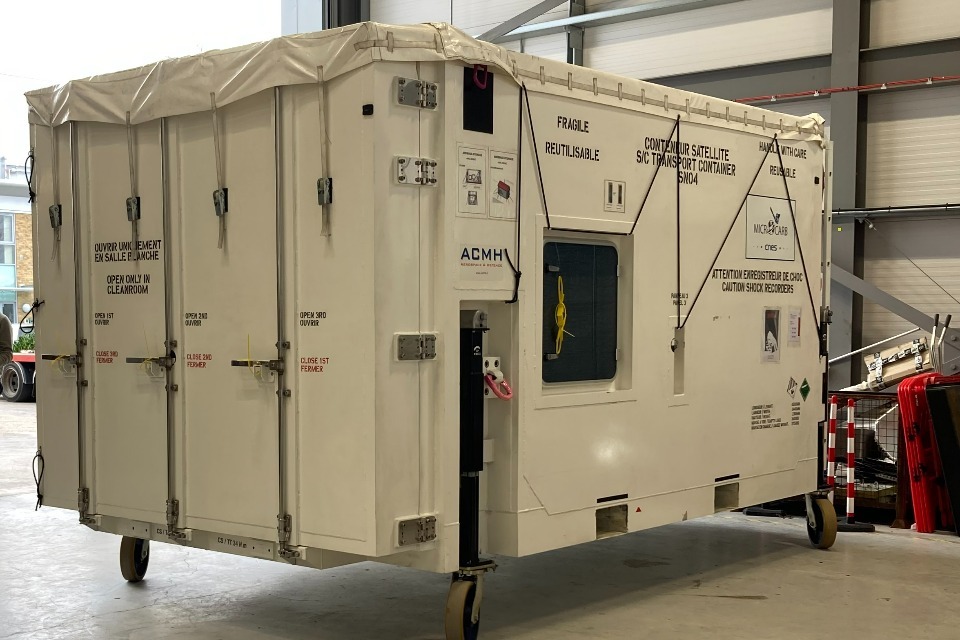
The first European space mission designed to monitor carbon fluxes on Earth by precisely measuring carbon dioxide in the atmosphere has completed assembly and qualification in the UK
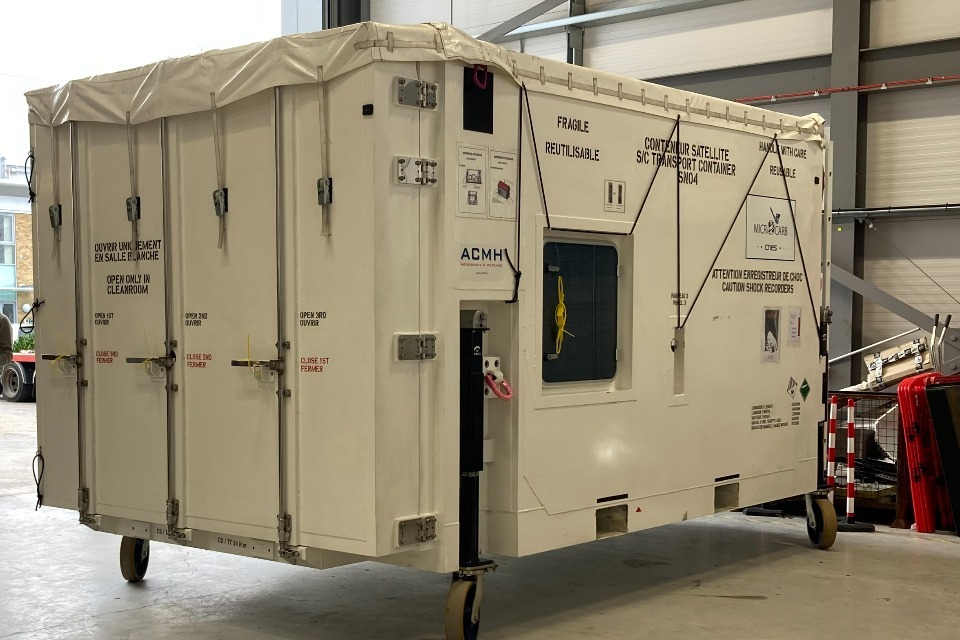
The MicroCarb satellite was delivered by Thales Alenia Space in the UK (TAS UK) on the Harwell Science and Innovation Campus in Oxfordshire, and is on its way to Toulouse, France, where it will await shipment for launch.
The satellite is designed to quantify sources and sinks of carbon dioxide (CO2)—the principal greenhouse gas—on a global scale. Currently, a lack of data makes it difficult to measure how much CO2 is absorbed by and released into the atmosphere, but such information is vital to gain deeper insights into natural carbon fluxes and inform climate models.
Andrew Griffith MP, Minister for Space at the Department for Science, Innovation and Technology, said:
The mission marks a major step for Europe towards establishing a system to monitor global CO2 fluxes. With its compact technology, MicroCarb will enable scientists to estimate concentrations of CO2 in the atmosphere with a high degree of precision, to around one molecule per million molecules of dry air (1 ppm).
This is thanks to an instrument known as a passive spectrometer, capable of measuring quantities of carbon absorbed by ecosystems to learn more about the exchange mechanisms at work and how they are being affected by climate change.
CNES, the French space agency, was tasked by the French government with overseeing and executing the MicroCarb mission, in partnership with the UK Space Agency and the European Union, which are providing additional funding (£13.9 million from the UK Space Agency). CNES chose Airbus Defence & Space in Toulouse to design and build the instrument and the satellite is built around the agency’s Myriade microsatellite bus.
The satellite arrived at RAL Space’s satellite test facilities in December 2022. RAL Space previously contributed to the design, qualification, and delivery of MicroCarb’s pointing and calibration system. Over the last year, the satellite has undergone a successful assembly, integration and testing phase, led by TAS UK with support from RAL Space and the UK Space Agency. This involved a series of vibration and thermal vacuum tests; the last stage of environmental testing before verifying its propulsion system.
The satellite is now qualified for the space environment and is travelling from Harwell to Thales Alenia Space’s facility in Toulouse to be stored and then prepared for launch.
Dr Paul Bate, Chief Executive of the UK Space Agency, said:
Philippe Baptiste, Chairman and Chief Executive of CNES, said:
François-Marie Bréon, the instrument principal investigator (PI), from the Laboratory for Climate and Environmental Sciences in France, said:
Dr Sarah Beardsley, Director of STFC RAL Space, said:
Following storage and launch (from 2025), the UK will continue to be involved in monitoring solar-induced fluorescence - which measures unused solar energy emitted by plants as heat and light - while the satellite is in orbit.