
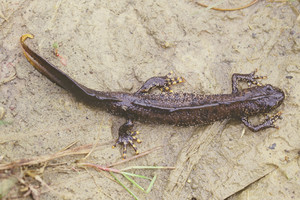
A Natural England scheme has boosted Essex’s pond habitats in just five months, helping to protect the UK’s threatened population of great crested newts
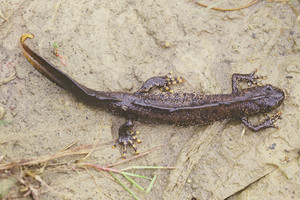
The district-level licensing initiative has led to the creation or restoration of 40 ponds across the county since it launched in March this year.
Investing in habitat
The scheme works by taking payments from building developers and investing them in four times the number of pond habitats that would have been impacted by their construction projects.
In the past, landowners and housing developers in Essex had to apply for a licence before building on or around the newts’ pond habitat – on a site-by-site basis. Seasonal restrictions led to delays and uncertainty over the costs and scheduling of planned development.
One simple application
Now, licensing is applied at a district level. This ‘landscape-scale’ approach means that developers need only make a single application and payment to join their local, area-wide scheme.
The one-off payment covers the creation, restoration, maintenance and monitoring of ponds around the area for 25 years, in locations chosen to provide the best habitat and most benefit.
Building back greener
The initiative contributes to the government’s plans to fast-track building projects, ‘Build Back Greener’ and fuel the UK’s economic recovery. And it helps put an end to the costly delays and uncertainty faced by developers building in areas where great crested newts are present.
But newts aren’t the only ones to benefit. Across the country the rich, watery habitat supports two-thirds of Britain’s freshwater plant and animal species, as well as provides social and economic benefits for local communities, including jobs.
Largest scheme yet
Essex’s scheme is the largest district-level licensing scheme to date, covering all 15 of the county’s planning authorities – an area of around 3,600 square kilometres.
The area has traditionally been a stronghold for the great crested newt, which are present in around 46% of the county’s ponds. But they’re under threat.
Despite being defended under UK and EU law, the iconic and rare amphibian has seen its preferred pond habitat decline by 50% over the last 60 years. And that’s contributed to the dramatic decline in the creature’s population. District level licensing aims to reverse that decline.
Essex was selected as a priority for the scheme due to the scale of development in the county.
Jeremy Potter, chairman of the Essex Planning Officers Association, said:
Neil Harvey, natural environment manager at Essex County Council’s Place Services, said:
Miranda Cooper, conservation and land manager at Essex and Suffolk Water, said:
Aidan Lonergan, West Anglia area manager at Natural England, said:
Essex is one of 77 local authorities with district-level licensing schemes. Natural England is working to expand the initiative to 150 local authorities across the country, as part of a programme funded by the Ministry of Housing, Communities and Local Government.
Find out more about district-level licensing and apply to join a local scheme