
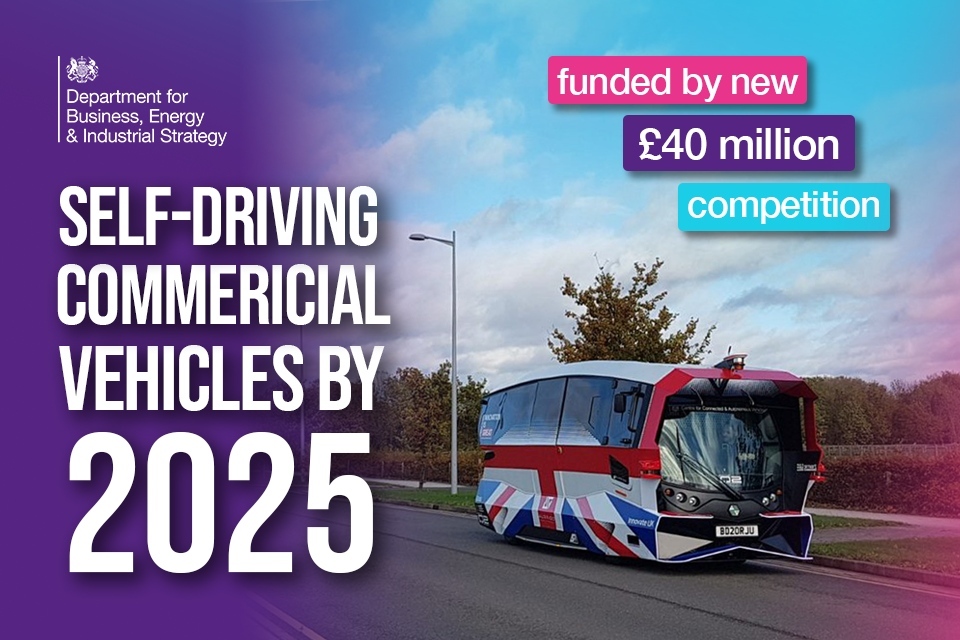
A new £40 million competition to kick-start commercial self-driving services, such as delivery vehicles and passenger shuttles, has been launched today
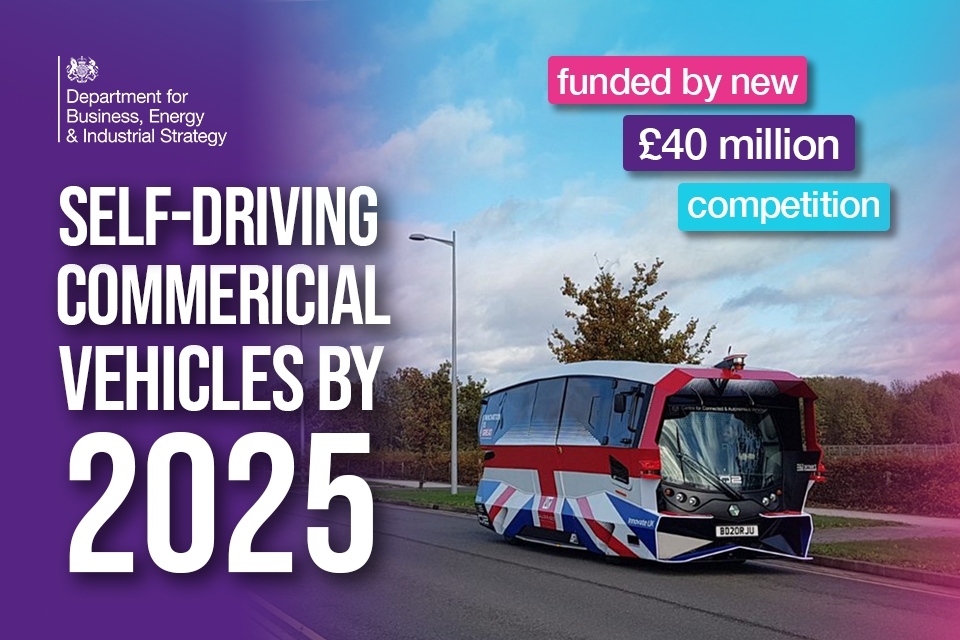
A new £40 million competition to kick-start commercial self-driving services, such as delivery vehicles and passenger shuttles, has been launched today (Monday 23 May) by Lord Grimstone, Minister for Investment. The funding could create tens of thousands of skilled jobs across the UK over the next decade.
The ‘Commercialising Connected and Automated Mobility’ competition will provide grants to help roll out commercial use self-driving vehicles across the UK from 2025, delivering convenience for consumers and making journeys safer, greener and more reliable.
The competition will help bring together companies and investors so that sustainable business models to be rolled out nationally and exported globally.
Types of self-driving vehicles that could be deployed include delivery vans, passenger buses, shuttles and pods, as well as vehicles that move people and luggage at airports and containers at shipping ports.
Minister for Investment Lord Grimstone said:
Transport Minister Trudy Harrison said:
The competition will cement the UK’s reputation as a global leader in self-driving vehicle technology, unlocking a new industry that could be worth £42 billion to the UK economy by 2035, potentially creating 38,000 new skilled jobs.
£1.5 million of the funding will be used to study and explore using self-driving vehicles as a means of public transport that could provide an alternative to mass transit systems. This includes, for example, using self-driving vehicles on routes separated from other traffic that could be cheaper and more flexible than new railway lines.
The UK government is continuing to develop a comprehensive legal and assurance framework for self-driving vehicles to ensure the safety of the technology. The government announced a Transport Bill in the recent Queen’s Speech that will introduce comprehensive legislation for self-driving vehicles to enable safe and responsible deployment.
The first vehicles to be listed as self-driving in the UK – vehicles approved under the Automated Lane Keeping System (ALKS) Regulation – could be available for people to purchase, lease or rent later this year. Vehicles will undergo rigorous testing and will only be permitted to drive themselves when they have met stringent standards.
The work undertaken by the government and its partners has already ensured that the UK has a proven track record in leading connected and self-driving vehicle innovation, enabling joint public and private investment of £440 million.
Society of Motor Manufacturers and Traders Chief Executive Mike Hawes said:
Notes to Editors
Interested parties can find out more about the competition, which is run by the Centre for Connected and Autonomous Vehicles (CCAV).
Government will be introducing a comprehensive legal framework to ensure safe and responsible deployment of self-driving vehicles.
Vehicles will undergo rigorous testing and only be approved as self-driving when they have met stringent standards and can safely and lawfully drive themselves without driver monitoring.
Drivers with existing technology, such as assistance systems like cruise control, auto start/stop and lane tracking, must always remain in control of their vehicle – these products are not defined as self-driving.
Currently, there are no vehicles approved for self-driving on Britain’s roads meaning drivers must always remain in control of the vehicle.
In 2035, 80% of the Britain’s jobs relating to CAV technology production are estimated to be in software-related industries, where Britain’s capabilities are strong, the value of the technologies is high, and the labour intensity of production is high. The remaining 20% would be in the production of CAV hardware such as sensors. Over 90% of the jobs created in developing CAV software and over 80% of the jobs relating to the manufacture of CAV hardware are expected to be in professional, technical and skilled trade occupations.
Government is working closely with industry and academia to ensure that these safety benefits are realised as the technology becomes more advanced, for instance by educating drivers so that they understand how to use self-driving vehicles.
In 2020, 88% of road accidents were caused by human error. SMMT estimate self-driving vehicles to save 3,900 lives and prevent 47,000 serious accidents by 2030.
The potential economic and societal benefits of the technology in the UK are vast. The Connected Places Catapult market forecast for connected and autonomous vehicles 2020 forecasts that in 2035, 40% of new UK car sales could have self-driving capabilities, with a total market value of £41.7 billion. This could in turn create 38,000 new skilled jobs.
About the Centre for Connected and Autonomous Vehicles
The Centre for Connected and Autonomous Vehicles (CCAV) is a joint Department for Business, Energy and Industrial Strategy (BEIS) and Department for Transport (DfT) unit.
Established in 2015, CCAV is an expert unit that is working with industry and academia to make everyday journeys greener, safer, more flexible and more reliable by shaping the safe and secure emergence of connected and self-driving vehicles in the UK and by leading the government’s Future of Transport strategy.
CCAV is developing regulation, investing in innovation and skills and engaging the public to realise the benefits of new transport technologies and to create a thriving connected and self-driving vehicle sector in the UK. It uses its unique position to bring together world-class expertise from across the public, private and academic sectors to create an environment in the UK for new technologies and business models where innovation, safety and regulation are delivered in unison.