
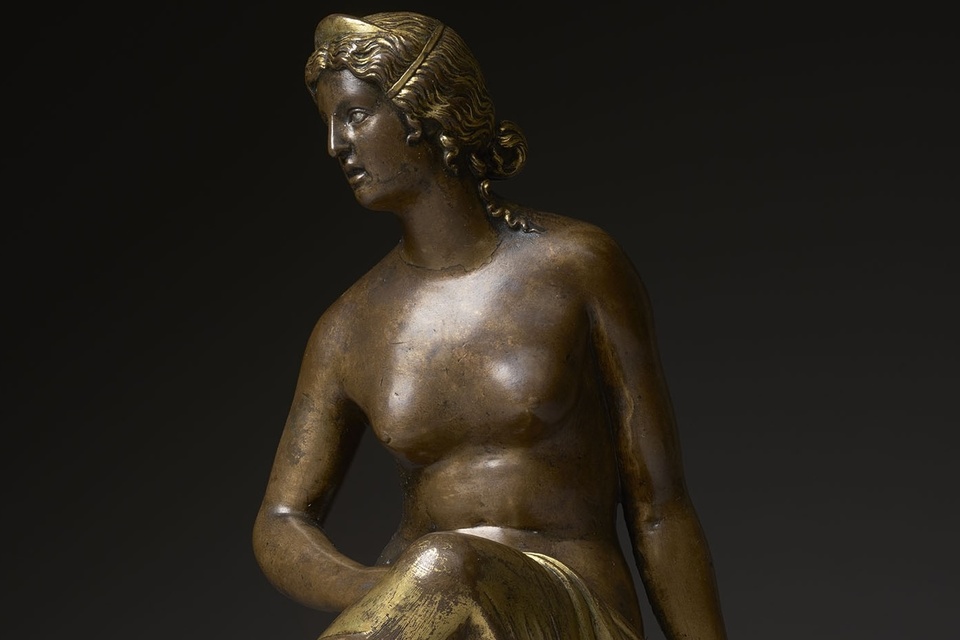
- UK galleries given the chance to save the £4.6 million Renaissance masterpiece for the nation
- Museums and galleries have until 17 December to come forward, helping keep the rare work on public display
The temporary export bar gives museums and galleries time to raise the £4.6 million needed to acquire the sculpture and keep it in the UK and on public display.
Cast over 500 years ago, the bronze statuette features mercury-gilded hair and drapery, with the exceptional detail and finish for which its sculptor became renowned.
The Seated Nymph was created by Italian sculptor Pier Jacopo Alari Bonacolsi, known as Antico, and is regarded as one of his finest works.
A deadline of 17 December has been set to find a buyer and help keep the rare Renaissance sculpture in the UK and on public display.
The figure stands just under 20cm tall and was likely designed to be held in the hand and turned to be fully appreciated. The tiara on the figure’s head suggests she may represent a goddess, such as Venus.
Arts Minister, Ruth Mackenzie said:
This statuette is small but mighty. The detail and refinement mark it out as an exceptional piece.
I very much hope this export bar can help keep this exquisite statue in the country where the public can also enjoy its beauty.
RCEWA committee member, Stuart Lochhead said:
Pier Jacopo Alari Bonacolsi, known as Antico, forever linked his fame with his skill at imitating classical antiquity. He developed a highly sophisticated technique for producing luxuriously finished bronze statuettes, becoming one of the leading artists at the court of Mantua. The Seated Nymph is one of his most beautiful creations, embellished with golden hair and drapery, as well as inlaid silver eyes. It was rediscovered in the sculpture collection at Woburn Abbey. The export of this exquisite sculpture from the UK would be a great loss, depriving the public of the work of an exceptionally rare and hugely admired sculptor.
The decision follows the advice of the Reviewing Committee on the Export of Works of Art and Objects of Cultural Interest (RCEWA).
The Committee made its recommendation on the basis that the Seated Nymph by Antico met the second and third Waverley criteria for its outstanding aesthetic importance and its outstanding significance to the study of the history of sculpture collecting in the UK, and within the context of the Bedford collection specifically, and the interrelationship between Antico models.
The decision on the export licence application for the sculpture will be deferred for an initial period ending on 17 December 2026 inclusive in which we welcome expressions of interest from an appropriate purchaser to try and acquire the object. At the end of the first deferral period owners will have a consideration period of 15 Business Days to consider any offer(s) to purchase the sculpture at the recommended price of £4,600,000 (plus VAT of £166,666.67). The second deferral period will commence following the signing of an Option Agreement and will last for five months.
Notes to Editors
- Organisations or individuals interested in purchasing the sculpture should contact the RCEWA on 02072680534 or rcewa@artscouncil.org.uk.
- Details of the ITEM are as follows: Pier Jacopo Alari Bonacolsi (about 1455-1528), known as Antico, Seated Nymph, about 1503(?). Bronze, with mercury-gilding on the hair and drapery, and silver-inlaid eyes. Height of the figure: 19.5 cm; Height including bronze base: 22 cm
- Provenance: [Possibly: Isabella d’Este, Marchioness of Mantua, Castello San Giorgio, Mantua, in 1503, and probably still in the Este family’s possession, Modena, in 1684. Alternatively, possibly: Gianfrancesco Gonzaga, by 1496 (inventory of estate, 8 October 1496, fol. 7r: ‘una figure cum le gambe incrosate de metale’); or Bishop Ludovico Gonzaga (c.1460-1511), or another member of the Gonzaga Family, Mantua, c.1496-11; by descent, until acquired with the Gonzaga collections by King Charles I, 1627/28; sold from the Royal Collection during the Commonwealth Sales, c.1649-54.] The Dukes of Bedford, London and Woburn Abbey, certainly by 1861, [but probably acquired by John Russell, 6th Duke (1766-1839), or an ancestor;] and by descent until sold by the Trustees of the Bedford Estates, Sotheby’s, London, 8 December 2009 (51), where purchased by the present owner.
- The Reviewing Committee on the Export of Works of Art and Objects of Cultural Interest is an independent body, serviced by Arts Council England (ACE), which advises the Secretary of State for Digital, Culture, Media and Sport on whether a cultural object, intended for export, is of national importance under specified criteria.