
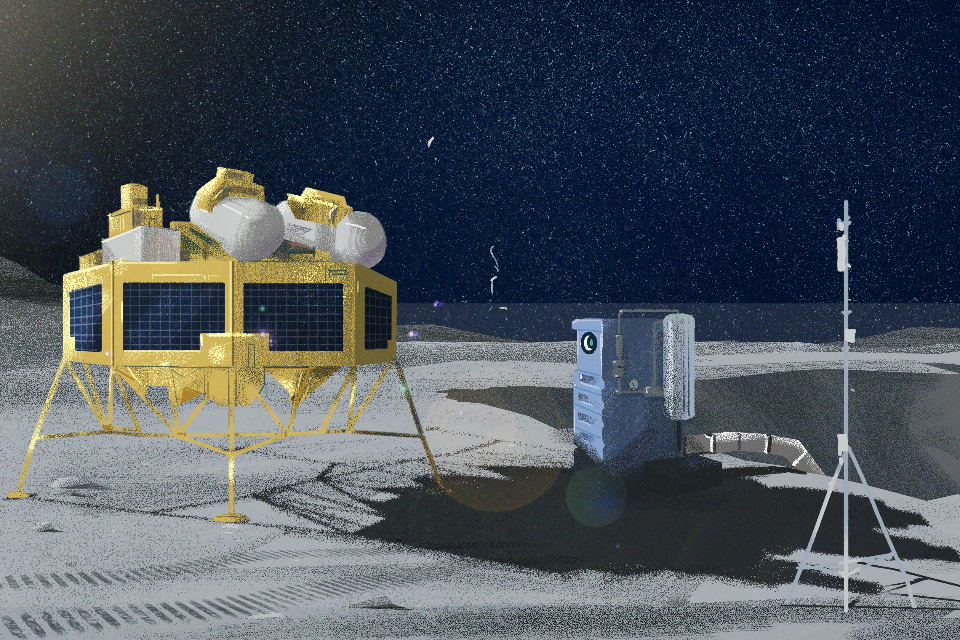
UK finalists awarded funding through the joint UK-Canada £1.2 million Aqualunar Challenge to develop new lunar water purifying technologies
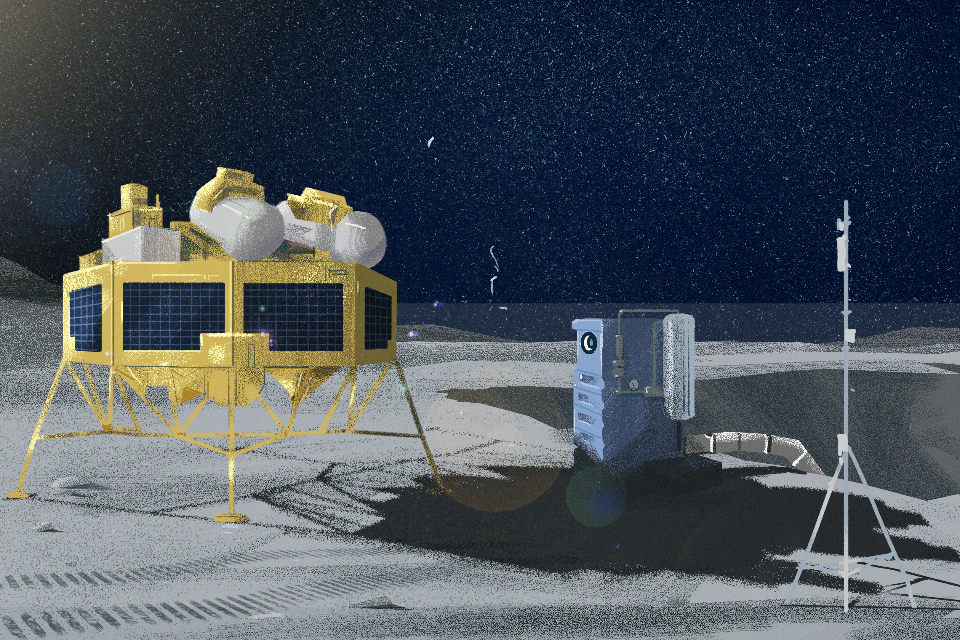
Ten cutting-edge teams of innovators, engineers and scientists, that are developing new technologies to provide a permanent crewed base on the Moon with reliable water supplies, have been named finalists in the Aqualunar Challenge.
The Aqualunar Challenge is part of a £1.2 million international prize funded by the UK Space Agency’s International Bilateral Fund and delivered by Challenge Works – experts in designing and running innovation challenge prizes.
The challenge is a collaboration with the Canadian Space Agency (CSA) and Impact Canada. The UK track of the challenge is awarding UK-led finalist teams £30,000 each to develop their technologies, before a winner and runners-up are announced in Spring 2025.
Around the lunar south pole, it’s estimated that 5.6% of the soil (regolith) is water frozen as ice. For a permanent crewed base on the moon to be possible, astronauts will need a reliable supply of water for drinking and growing food, as well as oxygen for air and hydrogen for fuel.
If the lunar ice can be successfully extracted, separated from the soil and purified, it makes NASA’s goal of establishing a base by the end of the decade viable. The Artemis campaign, as it is known, is supported by the UK Space Agency through its membership of the European Space Agency.
Paul Bate, CEO, UK Space Agency, said:
Explaining the importance of these new technologies, UK Space Agency reserve astronaut and chair of the Aqualunar Challenge judging panel, Meganne Christian, said:
The finalists include:
It is hoped that the technologies developed for the harsh environment of space will also be deployed on Earth, particularly in water-stressed regions and where access to clean drinking water is limited.
Holly Jamieson, executive director of Challenge Works, said:
Research by the Aqualunar Challenge found that 62% of people believe that technologies designed for space exploration should have applications on Earth, with more than half (56%) believing that using technology in space means we can better understand our own planet and how to protect it. 86% of respondents said they would like to see technologies being developed to purify lunar water adapted for use on Earth.
UK Space Agency and Challenge Works are working in collaboration with the Canadian Space Agency (CSA) and Impact Canada to deliver the Aqualunar Challenge. CSA will announce its cohort of teams for the Canada track later today.
To find out more about the Aqualunar Challenge in the UK and learn more about the ten finalists in detail, visit aqualunarchallenge.org.uk.
The ten finalist teams will be showcased at the Farnborough Air Show at 1pm on Friday 26 July in the Space Zone Theatre.
Full List of Finalists
AquaLunarPure: Supercritical Water Purification on the Moon – developed by Queen Mary University of London
A reactor would first heat lunar ice to leave behind dust and rock particles, then heat it to more than 373°C at 220 bars of pressure to turn it into “supercritical water” – not a solid, a liquid or a gas, but a fourth state that appears like a thick vapour – in which oxidation will remove all the contaminants in one step. Direct heating and insulation contribute to the high energy efficiency of this reactor, compared to current state of the art technologies.
Cyclic Volatile Extractor (CVE) – developed by Minima Design Ltd, Suffolk
The CVE will use a novel closed chamber to heat a batch of dirty ice to liberate volatile contaminants. The volume of the chamber can be actively changed to moderate its internal pressure. By regulating the temperature and pressure, different contaminants can be vapourised, liberated, collected and concentrated in separate storage systems.
FRANK – Filtered Regolith Aqua Neutralisation Kit – developed by RedSpace Ltd, Aldershot/Cleethorpes/Richmond (North Yorkshire)
A three-stage approach designed to deliver a continuous flow of drinking-grade water in a lunar environment would first heat the lunar soil (regolith) sample in a sealed chamber to separate off volatile gases and leave a liquid of water, methanol and regolith fragments. The liquid is passed through a membrane to remove solid particles. The remaining liquid is distilled to separate the methanol from the water.
Ganymede’s Chalice: Solar Concentrator Distillation for Clean Water Production – developed by British Interplanetary Society, London
A solar concentrator uses a curved mirror to focus the Sun’s rays on an air-locked crucible where lunar ice is placed by a small, automated crane. The heat from the concentrated rays boils the ice components one by one, and the system uses different storage mechanisms and chemical processes to store each component in safe and compact forms, finally condensing pure, drinkable water at the end.
I-LUNASYS: Innovative lunar water resource system – developed by Perspective Space-Tech Ltd, London
Using motorised pumps controlled by sensors, samples are heated at a constant pressure to separate and remove impurities as gas (isobaric vaporisation, followed by isothermal distillation). Using membranes and carbon filters, reverse osmosis separates the water molecules from the sample before entering a final UV filtration system. The system would be designed to be maintained by robots and could have new processes easily plugged into the system using “fluidic circuitry boards”.
Lunasonic – developed by Shaun Fletcher and Dr Lukman Yusuf, School of Chemistry, University of Glasgow
Dirty ice would be melted and large soil particles removed, before the water is pumped into a “sonoreactor” which uses ultrasound to split and remove volatile compounds and gases, destroy pollutants and cause lunar dust to clump together for easy removal. It then passes the water through a filter bed of lunar soil (rich in calcium, magnesium and aluminium oxides) to remove final contaminants – similar to how a household water filter works.
Regolith Ice Plasma Purifier for Lunar Exploration (RIPPLE) – developed by Regolithix Ltd, West Yorkshire
Dirty lunar ice would be fed into a reactor and heated to a water vapour. The vapour and solid regolith particles are fed into a vortex phase separator – similar to how a salad spinner flings water from lettuce leaves, the vortex flings the solid particles to the edge of the vortex to drop to the bottom while the gas exits from the top. The gas is fed into a plasma torch which breaks it into its constituent parts and a molecular sieve isolates the hydrogen and oxygen for water and fuel.
SonoChem System – developed by Naicker Scientific Ltd, Gloucestershire
The SonoChem System employs a groundbreaking core technology to purify water derived from lunar ice. Harnessing powerful sound waves, it spontaneously forms millions of tiny bubbles in contaminated water. The extreme temperature and pressure created within each micro bubble generates free radicals (unstable atoms which are highly chemically reactive) which effectively removes contaminants.
Static Water Extraction System (SWES) – developed by Interstellar Mapping, London. Lunar soil (regolith) would be fed into a reservoir
Using series of pressure seals and heating elements, different volatile substances in the sample that can be sublimated (i.e. turned from a solid into a gas without becoming a liquid) at lower temperatures than ice/water are extracted and stored, then the sample is heated again to turn the water to steam which is extracted and cooled. The system has no moving parts and is envisaged to operate for years with little maintenance.
Titania-Diamond Annular Reactor (TiDAR) – developed by Nascent Semiconductor Ltd, County Durham
The compact system employs a combination of UV light from LEDs to activate a titania catalyst and robust diamond electrodes, which are durable enough to endure the abrasive lunar soil and the G-forces experienced during launch. This combined system rapidly breaks down harmful organic and inorganic components in the lunar soil to create safe drinking water and even useful materials, such as rocket fuel from methanol.
Notes to Editors
For media enquiries, please contact Andrew McKay, Zofia Tanaka, Jeevan Randhawa and Emma Harvey at aqualunar@seven-consultancy.com or call +44 (0)20 7754 3610.
Methodology
Opinium surveyed a nationally representative sample of 2,000 adults in the UK between 12 December and 15 December 2023. The data used in this release has been reviewed and approved by Opinium.
About the UK Space Agency
The UK Space Agency inspires and leads the UK in space to benefit our planet and its people. It is an executive agency, sponsored by the Department for Science, Innovation and Technology.
About Challenge Works
Challenge Works is a global leader in designing and delivering high-impact challenge prizes that incentivise cutting-edge innovation for social good. It is part of UK innovation foundation agency Nesta. For more than a decade, it has run more than 80 prizes, distributed more than £100 million in funding and engaged with 12,000 innovators.