
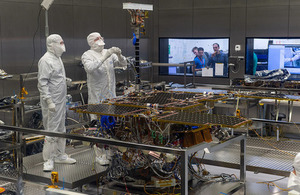
The ‘PanCam’ apparatus is the scientific ‘eyes’ of the rover, which will give scientists a view of the Martian terrain and geological features so that they can drive the rover named after the British scientist Rosalind Franklin who co-discovered the structure of DNA.
The rover will be able to observe Martian atmospheric phenomena like its fierce dust storms that cover the entire planet lasting for many months. and water in the atmosphere.
The UK is taking a leading role in the Rosalind Franklin Mars rover, part of the European Space Agency’s (ESA) ExoMars mission to examine the geological environment on Mars, which is 140 million miles on average away from Earth, and search for evidence of environments that may have once, and perhaps could still support life.
Jo Johnson, Science Minister said:
With funding and support from the UK Space Agency and European Space Agency (ESA), PanCam was developed in Britain by scientists from UCL’s Mullard Space Science Laboratory (MSSL), working with the University of Aberystwyth and dozens of other experts across the UK in partnership with colleagues in Switzerland, Germany, Austria and scientists from 9 nations.
Professor Andrew Coates, PanCam Principal Investigator from the UCL Mullard Space Science Laboratory, said:
The camera system was fitted to the rover at Airbus Defence and Space in Stevenage, Hertfordshire, which is building Rosalind Franklin.
UK scientists from the University of Leicester and Teledyne e2v are also working on the rover’s Raman Spectrometer, a powerful tool for the identification and characterisation of Martian minerals. The UK Science and Technology Facilities Council is providing some of the electronics, including the data processing board.
Colin Paynter, Managing Director of Airbus Defence and Space UK said:
The UK Space Agency is the second largest European contributor to the ESA-Roscosmos ExoMars mission, having invested €287 million in the mission and £14 million on the instruments. This, in addition to successful negotiations with ESA, secured key mission contracts for the UK space sector.
Later this month Rosalind Franklin will begin its long journey to Mars - leaving the UK for testing in Toulouse before launching to the red planet next summer (2020).
The UK is a leading member of ESA. In June the UK led Comet Interceptor mission, proposed and led by UCL researchers, was selected by ESA. This mission will send a spacecraft to chase down, observe and study a comet which has never previously encountered the inner Solar System giving us vital information about the conditions of the early Solar System and understand its formation.
The Government’s modern Industrial Strategy is backing businesses to succeed by increasing investment in science, because countries that invest in ideas create more opportunities for business. The ambition is for the UK be the world’s most innovative economy – and the development of the ExoMars rover for the UK is a part of this ambition.