
The Book of Jonah is only forty-eight verses long, but it is one of the most popular books of the Tanakh. And it is read on Yom Kippur during the afternoon service. Its message is G-D’s care for all creatures and it would be concerned with forgiveness and forgetting, but neither is featured here.
Some 2750 years ago Assyria was the most powerful and warlike nation in the Middle East. The Israelites on the other hand were divided into two countries that fought each other. Judea in the South comprised two tribes ruled over by the dynasty of King David. Israel, in the North, had ten tribes and was pagan. In 720 BCE the northern Kingdom was destroyed by the Assyrians. In 586 BCE, the southern Kingdom was destroyed by the Babylonians. Reminiscent of current divisions in Israel!
Jonah was a citizen of the North. He was told by G-D to go to Nineveh the capital of Assyria, also corrupt, and get them to repent. Jonah did not want to do this and ran away, thus threatening his relationship with G-D, and avoiding his moral responsibility. He knew that if he got Assyria to repent, it would be the agent of G-D in destroying his homeland, the northern Kingdom.
He took a boat from Jaffa headed north towards Tarshish, Tyre. The Phoenicians, the Sea Peoples who inhabited that coast, were the archenemies of the Assyrians. Once at sea, a fierce storm hit the boat, and it was about to break up. The crew of pagans started to pray to their gods to save them from drowning at sea and threw containers overboard to lighten the load. Meanwhile, Jonah went down to the hold of the boat and fell asleep. Reminiscent of Hamlet when the King of Denmark tried to send him to his death in England. In his depression, he too fell asleep at the bottom of the boat.
The sailors rebuked Jonah and told him to pull his weight and pray too. To no avail. The ship seemed doomed. They decided to cast lots to find out who was responsible for the storm. And the lot fell on Jonah. They turned to Jonah and asked him who he was. Jonah admitted he was a Hebrew and the cause of G-D’s anger. He told them to throw him into the sea.
They, being good people, and no antisemites, at first refused and tried harder to get back to land. But in vain and finally, they relented, appealed to G-D for forgiveness, and overboard went Jonah. The storm immediately died down. They gratefully accepted the One G-D as theirs and we bid them goodbye.
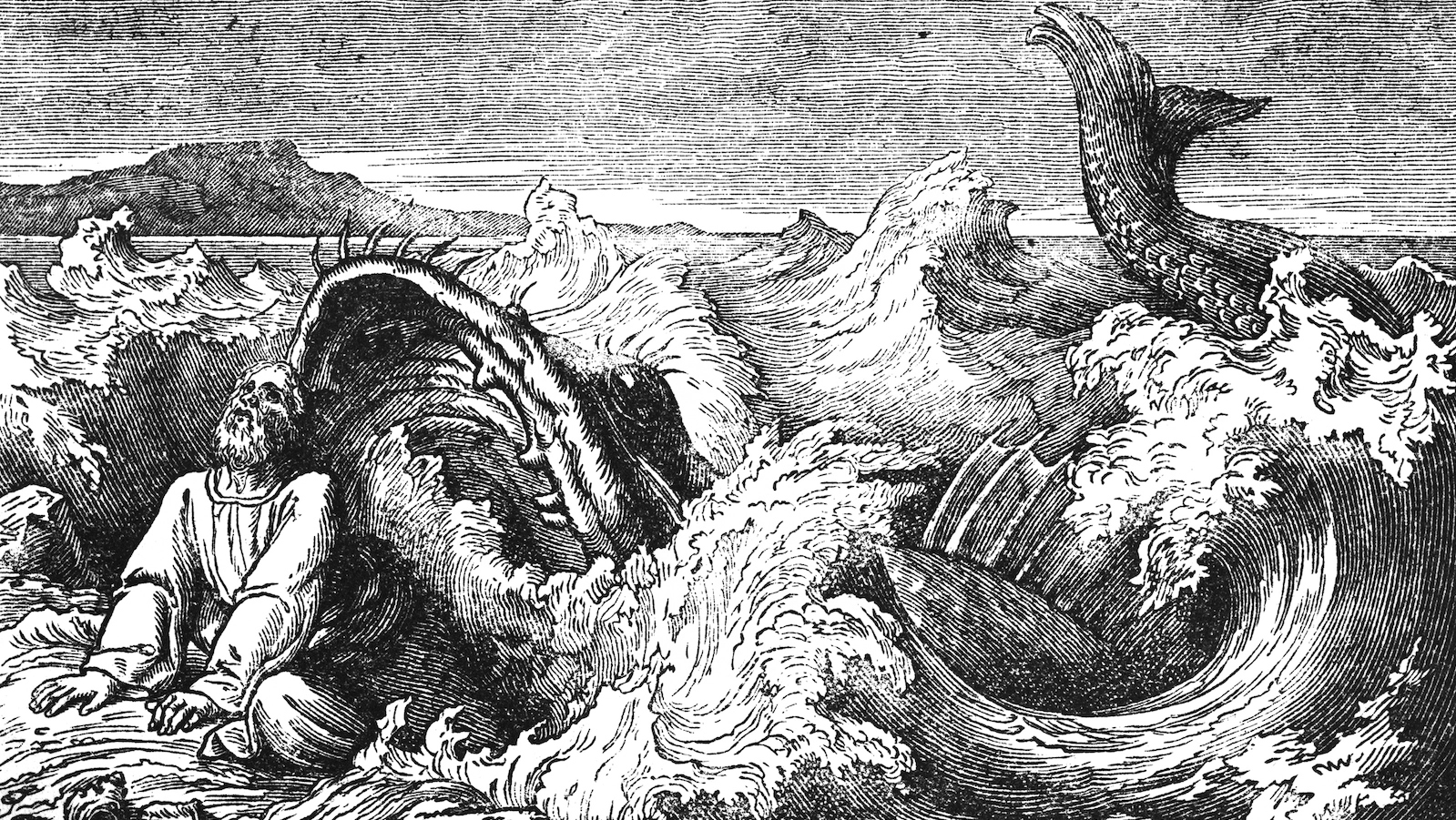
Jonah was swallowed by a fish. And he was in this fish for three days. There he repented and appealed to G-D in a beautiful poem and promised to do as he was told. G-D commanded the fish to spew him out onto dry land. And G-D once again commanded him again to go to Nineveh and this time he did.
Nineveh was a huge city three days journey across. He ventured one day in and started to preach that Nineveh would be destroyed in forty days (an interesting number). And they believed him something he could not achieve at home. Hence the well-known saying that a prophet is never heard in his own city. They declared a fast and the King too got up from his throne and took off his fine clothes, covered himself in sackcloth, sat in the dust, and instructed everyone, humans, and animals to fast, not drink water, and pray for forgiveness. G-D saw that they had repented and forgave them.
Jonah was not happy. He complained that this was precisely why he ran away in the first place! And he begged G-D to kill him so that he wouldn’t have to witness the awful consequences of the destruction of his homeland. And G-D responded, “ Are you sure you are right to be upset?”Jonah left the city and went to sit overlooking it. He made a little booth to sit in its shade. G-D got a plant to quickly grow over the booth giving him more shade from the fierce sun. Jonah was happy. But then G-D arranged for a worm to attack the tree and it died. Unbearable heat bore down on Jonah, and he begged to die. G-D then asked him if he cared about the plant. And Jonah said he did. To which G-D replied, “ If you cared about a plant that you did not plant and had nothing to do with its flourishing, why shouldn’t I care about a whole city of 120,000 people and all its Animals?”
One wonders why G-D wanted to destroy Israel because they were corrupt and not Nineveh which was too? Perhaps because as it says, “The people in Nineveh couldn’t tell good from bad.” They knew no better. Whereas the people of Israel did. The amazing message is G-D cares about everything on earth ( animals included) not only the Children of Israel. It is being a good human that counts. Jonah lived in a corrupt society even if they were Israelites. G-D’s message clearly was that a non-Jewish society that is moral and good is preferable to one that is not, regardless of its origin or history. And it’s a powerful message. Even more so on Yom Kippur when we expect G-D to forgive us. But why should we expect it, if we continue to fail? There is no silver bullet, no guarantee or promise of preferential treatment or survival. We are the architects of our own rise or fall.
In my opinion, Jonah did not fully repent. Sure, in the fish’s stomach, he said, “I am sorry, and I will do the right thing.” And he did up to a point. He carried out his mission. But still, he was angry and sad about the consequences of his actions. That his own people would be destroyed. Most of us who fail or do wrong are ambivalent and we are reluctant to change. But the Tanakh constantly recognizes this ambivalence. We know what’s right and what we ought to do. And still, we go on failing. The tendency to give up is the real crime. Time and again Moses tells the Israelites that they ( and that includes us ) will fail. We should be repenting all the time but we need reminders. There is hope. As it says, in the Torah this week and haftarah next, if we return to G-D (or good), then G-D will return to us. Repentance is imperfect. It is not just a one-off act, but a process. And that is the message that resonates with me.
The capacity to forgive is divine. It is mentioned twice in the Torah and then only of G-D. And this is a story of G-D’s pity for humans and forgiveness. Humans are more limited. We can repent and we can change but we find it much harder to forgive or forget. Still, realizing our shortcomings is important so long as we can go forward and persevere. Jonah does neither forgive nor forget. He remained depressed and did not have a reply to give to G-D. But he kept going. Which is one very good reason why we have survived.
Shabbat Shalom, have a meaningful fast and Gemar Tov.
###
Study the Tanakh with me
Study the text of the Tanakh with me with a combination of traditional, critical, and personal perspectives. No knowledge of Hebrew or the Tanakh is necessary. I will start where we left off last year in Shemot 21.
Every Wednesday at 9 a.m. EST starting September 27th All sessions are recorded and available. Free on Lockdown University. Just join at judi@parway.co.uk.