
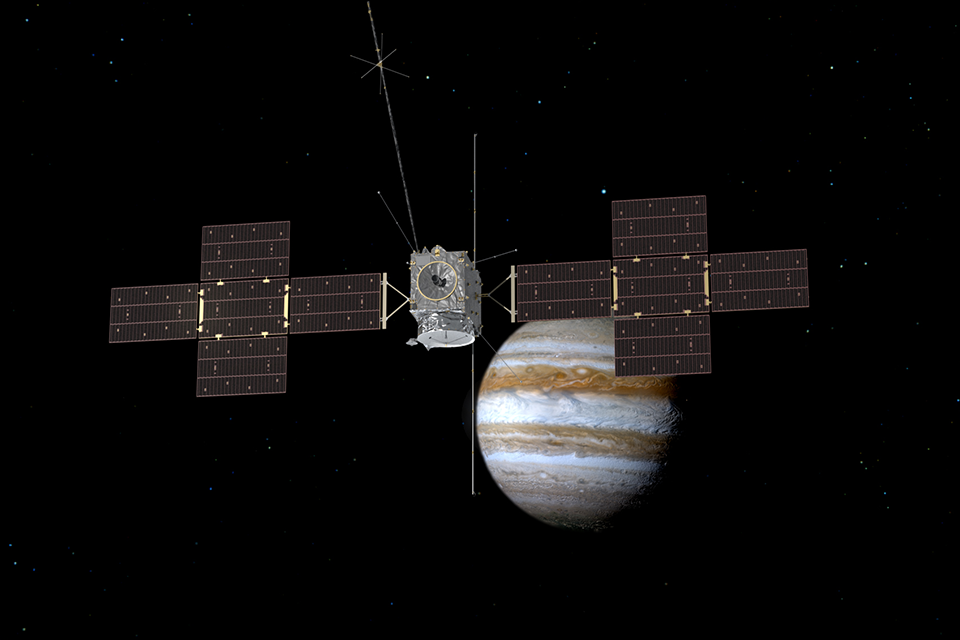
The mission will study Jupiter's moons for potential habitability for life
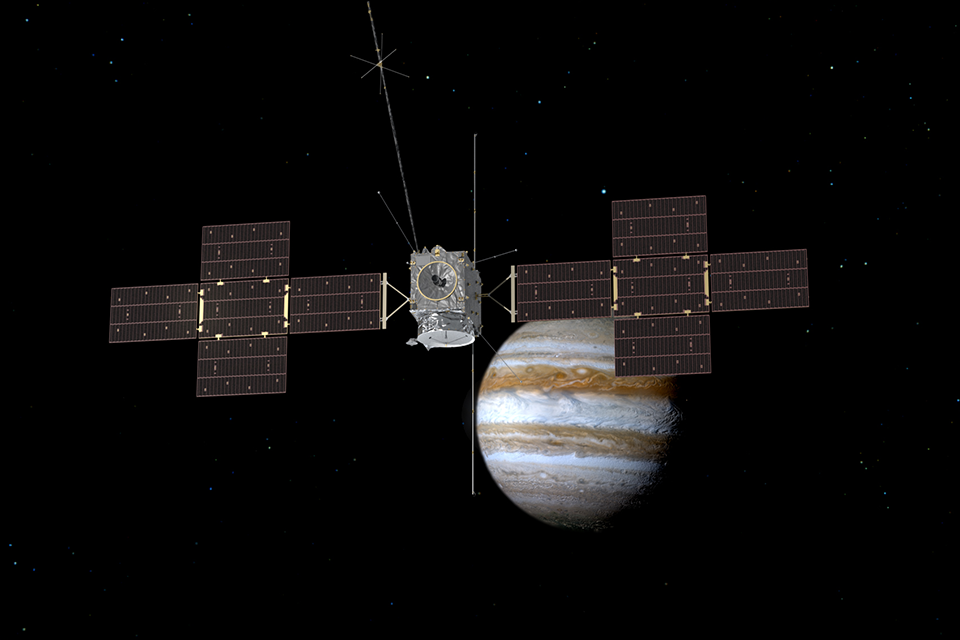
The Jupiter icy moons mission (JUICE) has taken off on its journey to study Jupiter, our largest planet, and investigate whether some of its icy moons are home to conditions that could support life.
Funded by the UK Space Agency, the UK leads on one of the 10 science instruments on board the European Space Agency’s Jupiter Icy Moons Explorer (JUICE) and has contributed to the development of two more.
Blasting off from Kourou in French Guiana at 1:14pm BST on Friday 14 April, JUICE will spend eight years travelling to the Jupiter system. On the way, it will perform fly-bys of Earth and Venus, using the gravitational fields of the planets to generate enough speed to reach Jupiter.
One of these will be the first-ever lunar-Earth gravity assist manoeuvre.
Secretary of State for Science, Innovation and Technology, Michelle Donelan, said:
On arrival in 2031, JUICE will circle Jupiter and fly past moons Ganymede, Europa and Callisto, making observations and taking measurements, studying the Jovian system as an archetype for gas giants elsewhere in the universe.
Finally in December 2034, JUICE will transfer into orbit around Ganymede, becoming the first spacecraft ever to orbit a moon other than Earth’s. While up close and personal with Ganymede, the mission will investigate the giant ocean that scientists believe hides under its icy crust, seeking evidence of habitability.
Dr Caroline Harper, Head of Space Science at the UK Space Agency, said:
The UK Space Agency invested £9 million into the JUICE science payload, by supporting three critical instruments on board, which are:
Principal Investigator for the J-MAG instrument at Imperial College London, Professor Michele Dougherty, has been involved in JUICE since well before it was selected by ESA in 2014 as the first Large Class mission in its Cosmic Vision Science Programme.
Professor Michele Dougherty, Head of the Department of Physics at Imperial College London, said:
JUICE is a collaboration between ESA, NASA and the space agencies of Japan and Israel and will consider two key themes from ESA’s Cosmic Vision 2015 – 2025: What are the conditions for planet formation and the emergence of life? And how does the Solar System work?
After taking off on an Ariane 5 launch vehicle from Kourou in French Guiana it is expected to arrive at Jupiter in July 2031 and complete 35 icy moon flybys before arriving at Ganymede – the largest of Jupiter’s moons – by December 2034.
JUICE will spend its eight-year voyage productively; it will pass by Venus to test and calibrate its instruments, gather data and take advantage of the gravity assist to save on fuel.
Meanwhile, scientists on the ground will work on finalising software and data modelling in time for arrival at Jupiter.
Chiaki Crews, Research Fellow at the Open University, said:
Professor Geraint Jones at University College London’s Mullard Space Science Laboratory, said:
Professor Emma Bunce, Director of the Institute for Space at the University of Leicester, said:
After many years of hard work from science, engineering, and industry teams, we are so excited that the JUICE mission is finally ready to launch and start its long journey to the Jupiter system. We will patiently await the incredible data that we expect to receive from 2031, and we are confident that it will absolutely be worth the wait!”
Professor Manuel Grande, Head of Solar System Physics at Aberystwyth University’s Department of Physics, said:
Daniel Waller, Vice-President at Teledyne e2v, said: