
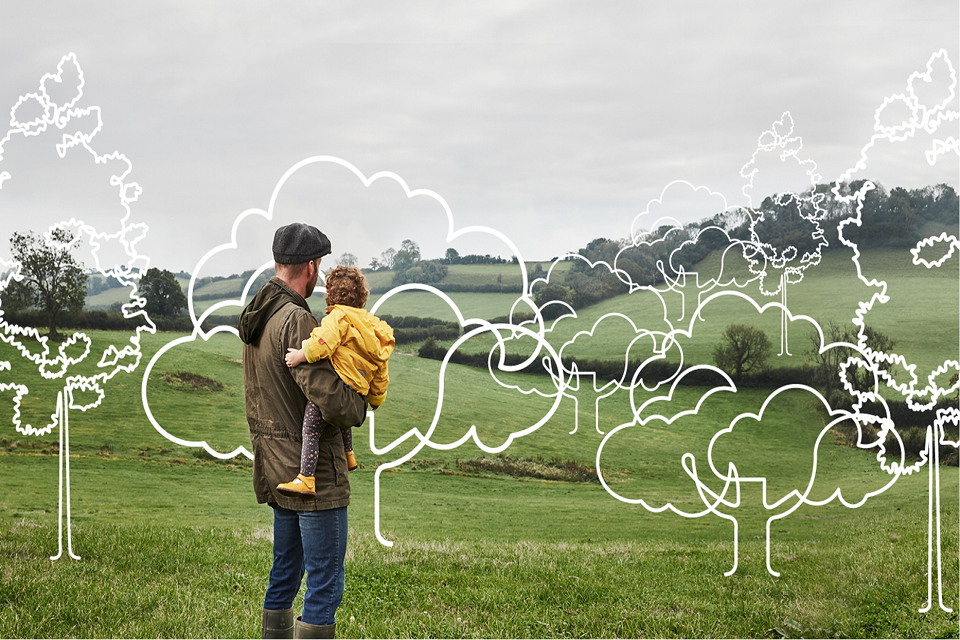
Farmers and landowners encouraged to create new woodland as a financial and environmentally rewarding option
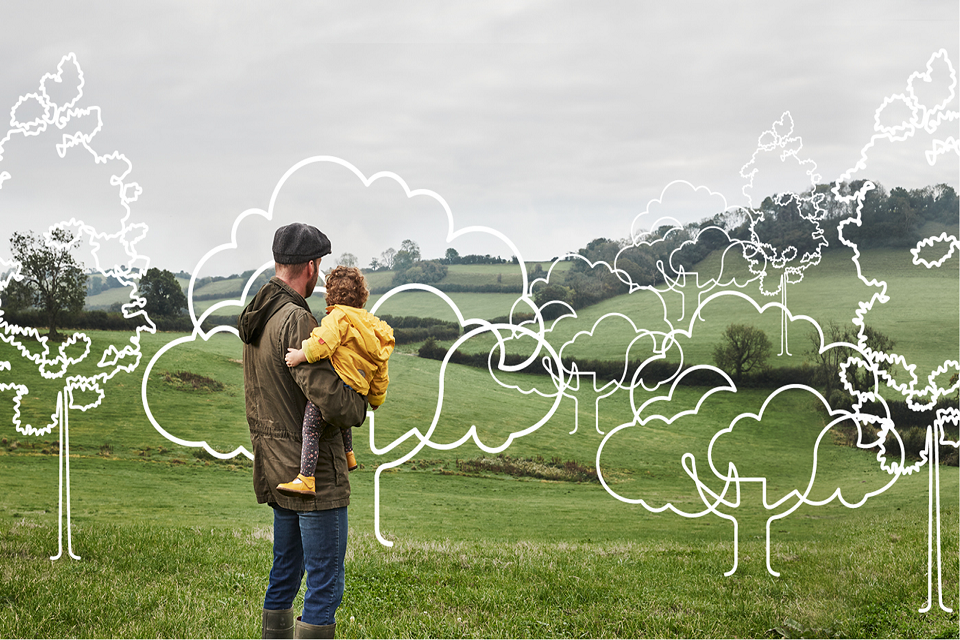
A new drive to encourage farmers and landowners across England to plant and manage more trees has been launched today.
Woodland creation offers a profitable way for farmers and landowners to boost their business as well as deliver environmental benefits, alongside food production. The Forestry Commission and Defra are drawing attention to the attractive grant schemes and free specialist advice available through a new campaign launching today.
The grant schemes will help land managers diversify their business, with the potential to receive a grant of over £10,000 for every hectare of new woodland created. Woodland creation is one of the options that farmers will have as part of England’s new agriculture policy which is being designed in partnership with industry, and which will reward them for the wide range of environmental outcomes they help to deliver alongside being our primary food producers.
Today’s drive follows publication of the England Trees Action Plan last year which committed to treble tree planting rates by the end of this Parliament – to at least 7,000 hectares of trees per year in England. This equates to just 0.08% of the 9.3 million hectares of farmland in England changing to woodland each year by the end of that period.
There are a variety of funding opportunities available to support the creation and management of new and existing woodlands, provided by both Defra, the Forestry Commission, and other woodland creation partnerships across England. Through the Forestry Commission’s England Woodland Creation Offer, farmers and landowners will be paid to create new woodland on areas as small as one hectare (and that can be made up of smaller plots) – from small scale planting on marginal or unproductive land to large mixed woodlands.
The Offer supports the creation of a range of woodland types and sizes, including: along rivers to improve the water environment; through natural colonisation; for sustainable forestry and where their location and design will provide public benefits including greater access to nature. With this support, converting marginal or unproductive land into new woodland can create additional income streams - without taking good agricultural land out of use.
Importantly, they will be able to transfer to an environmental land management scheme without having to repay the current funding, meaning there’s no need to delay planting trees now.
Tenant farmers can receive England Woodland Creation Offer funding if both they and their landlord are content with the tree planting proposals.
Farming Minister Victoria Prentis said:
Forestry Commission Chief Executive, Richard Stanford, said:
Mark Tufnell, President of the Country Land and Business Association, said:
Woodlands designed for multiple purposes can add value to farms and farm businesses, while complementing food production. The campaign highlights the range of public and environmental gains for biodiversity and people that growing trees on farmland can provide.
These benefits include: boosting biodiversity; providing access to nature; reducing soil erosion; absorbing carbon which can be sold as carbon credits; and protecting communities downstream from flood risk.
The Environment Secretary recently announced further details of England’s new agricultural policy with support for tree planting and woodland creation forming a key part of the plans to design a future farming system that works in the best interests of British farmers. By taking up grants such as the England Woodland Creation Offer now, farmers and landowners will be able to transfer into a future environmental scheme (Sustainable Farming Incentive, Local Nature Recovery and Landscape Recovery Schemes) at agreed points without having to repay their current funding. As the rollout of the environmental land management schemes progress, the Government will include further standards in the Sustainable Farming Incentive to deliver wider environmental outcomes, such as improving hedgerows and combining trees or shrubs with crop and livestock farming.
Through opportunities such as agroforestry, having a more wooded landscape can complement food production and livestock farming. This includes silvopasture systems where you can significantly increase the number of trees in the farmed landscape, alongside grazing systems for cattle and sheep.
Further, the National Food Strategy highlighted that the kind of land that could deliver the greatest environmental benefits is often not very agriculturally productive, with the most productive 33% of English land producing around 60% of the total output of the land, while the bottom 33% only produces 15%. Speaking recently at the Oxford Farming Conference, the Environment Secretary said:
The Government is committed to increase planting rates to 30,000 hectares per year across the whole UK by the end of this Parliament. This forms a key part of the UK’s efforts to tackle the twin challenges of climate change and biodiversity loss.
To get involved in the campaign you can contact putdownroots@defra.gov.uk and view the campaign site.