
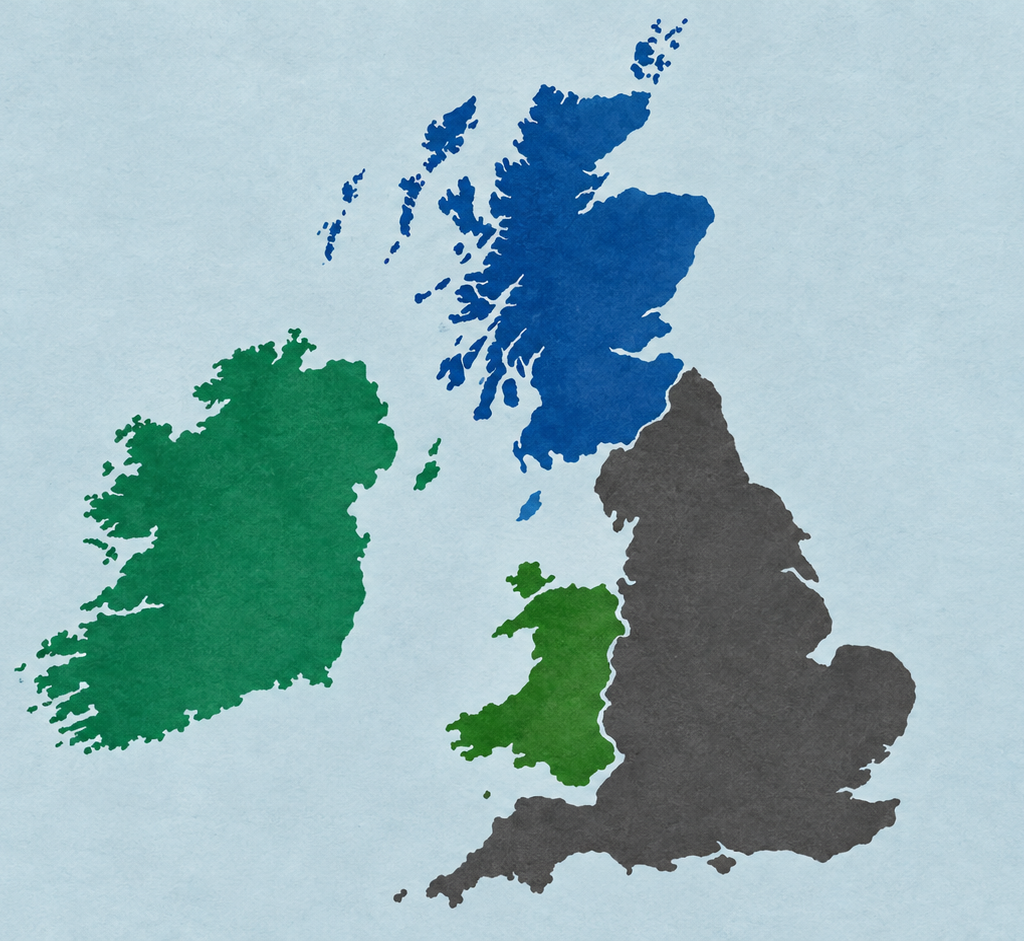
One argument should be disposed of immediately. Whenever Scottish independence, Welsh independence or Irish reunification is discussed, some disgruntled English voters demand that the departing nation repay the money it has received from the United Kingdom or assume a punitive share of the national debt.
This treats a political union as though it were a loan agreement. It is comparable to the principal breadwinner in a long marriage demanding repayment of everything spent on the household when the relationship ends. If membership of the Union provided no reciprocal benefit to England or the United Kingdom, one must ask why successive governments worked so determinedly to preserve it.
Public expenditure in Scotland, Wales and Northern Ireland was not advanced as credit. It was spent pursuant to constitutional arrangements approved and maintained by the United Kingdom. People and businesses in all three nations paid UK taxes, contributed labour, produced goods and services, served in the armed forces and participated in the economic and political life of the country.
That does not preclude an orderly separation agreement addressing jointly held assets and liabilities. It does mean that accumulated public expenditure cannot reasonably be converted retrospectively into a debt owed to England. The division of existing assets and liabilities would be a technical negotiation between governments, not a demand that departing citizens reimburse generations of public services.
With that question out of the way, the present financial position deserves serious examination.
I have long supported the reunification of Ireland. I also support Scottish independence and moved our group companies from England to Scotland partly because I believe Scotland should be able to determine its own constitutional future, with the objective of returning to the European Union. Although I have no comparable personal commitment to Welsh independence, having lived in Pontypridd for several years, I would support the people of Wales if they chose separation.
Supporting that principle does not require me to pretend that separation would be free. On the contrary, the strongest argument for self-determination begins with an honest acknowledgement of its price.
The latest directly comparable figures for the three nations demonstrate the scale of the issue. In 2022–23, Scotland raised approximately £87.5 billion in public revenue while receiving approximately £106.6 billion in public expenditure. Its fiscal shortfall was therefore about £19.1 billion, even after attributing an unusually high level of North Sea oil and gas revenue to Scotland.
Wales raised approximately £38 billion while public expenditure attributable to it was approximately £59–60 billion. Its shortfall was therefore around £21–22 billion.
Northern Ireland raised approximately £21.5 billion while receiving approximately £36 billion in public expenditure, producing a shortfall of about £14.5 billion.
Together, the three nations received approximately £55–56 billion more in public expenditure than they generated in revenue.
These figures cover more than the budgets administered in Edinburgh, Cardiff and Belfast. They include pensions, welfare payments, capital expenditure and each nation’s attributed share of UK-wide services and liabilities. They therefore do not represent three cheques that Westminster could cancel and immediately place £56 billion in a bank account.
Nevertheless, the underlying fiscal transfer is real. Scotland generated approximately 82 pence for every £1 spent for its benefit. Wales generated around 64 pence and Northern Ireland approximately 60 pence. The balance was supported through revenues raised elsewhere in the United Kingdom and through government borrowing, which will be repaid by the taxpayers.
It is simplistic to attribute the entire shortfall to every English taxpayer equally. Most English regions also recorded fiscal deficits. London and South East England were the principal regional fiscal contributors. However, from the perspective of the remaining United Kingdom—and particularly its taxpayers—the separation of all three nations could ultimately remove tens of billions of pounds in annual fiscal transfers.
There would be transitional costs. Some existing expenditure, including defence, debt interest, pensions and central administration, could not be eliminated immediately. Assets, liabilities and accrued obligations would have to be negotiated. Trade between the nations might be disrupted, and new governmental institutions would have to be created.
Even allowing for all those qualifications, it makes financial sense for Westminster to consider separation as an opportunity rather than merely a loss. If the people of Scotland and Wales wish to govern themselves, and if the people of Ireland vote for reunification, the remaining United Kingdom would have little justification for compelling them to remain while continuing to finance substantial annual shortfalls.
The response from some supporters of the Union is particularly curious because many of the same people supported Brexit. They insisted that sovereignty, democratic control and national independence were worth the economic price of leaving the European Union. They cannot logically celebrate British separation from Europe while denying Scotland, Wales and Northern Ireland the right to make the same calculation.
Brexit provides the clearest warning of what that calculation entails.
The United Kingdom was a net contributor to the EU budget, generally contributing approximately £8–10 billion more annually than it received through recorded EU expenditure. Brexit therefore produced an identifiable saving. But that saving must be measured against the economic consequences of leaving the Single Market and Customs Union.
British businesses now encounter customs declarations, rules-of-origin requirements, certification costs, regulatory duplication, border delays and more complicated VAT arrangements. These are not theoretical inconveniences. They require employees, agents, advisers, software and time.
Companies do not possess an independent reservoir from which these costs can be paid indefinitely. They recover them through higher prices, reduced investment, lower wages, diminished returns or narrower margins. In every case, the ultimate burden falls upon individuals: customers, employees, shareholders, pension holders and taxpayers.
Similarly, when government finances deteriorate, “the government” does not absorb the loss. Government has no money separate from the population. Reduced revenue and increased expenditure eventually mean higher taxes, greater borrowing, diminished public services or inflationary pressure. The public pays whether or not the cost appears as a separately itemised charge.
The Office for Budget Responsibility’s central assessment is that Brexit will leave UK productivity approximately 4% lower in the long term than it would have been under continued EU membership. Applied to an economy currently worth around £3 trillion annually, that implies approximately £120 billion in economic output forgone every year—about twelve times the net annual contribution the United Kingdom previously made to the EU budget. It means lower incomes, weaker profits and less tax revenue than the country would otherwise have enjoyed.
Brexit also failed against one of its most prominent political promises. It ended EU freedom of movement, but it did not produce lower overall migration. Legal migration shifted from European to non-European sources and subsequently rose to levels exceeding those experienced before Brexit. Recorded small-boat arrivals also increased from a few hundred annually before the UK left the EU to tens of thousands.
Brexit gave Westminster greater legal control over immigration. Successive governments then used that control to permit substantial migration while failing to control irregular Channel crossings. Judged against the promise of reduced immigration, Brexit has failed. Judged by its effect upon businesses and individual finances, Brexit has imposed significant and continuing costs—and therefore it has failed.
A person may still argue that British sovereignty was worth paying for. That is a political judgement rather than an economic conclusion. What cannot credibly be maintained is that sovereignty was acquired without cost.
The same honesty must govern the future of Scotland, Wales and Northern Ireland.
Scottish independence would create an immediate fiscal gap. EU membership could provide important long-term economic and political advantages, but it would not instantly replace approximately £19 billion in annual support. Scottish taxpayers would face some combination of higher taxation, reduced expenditure, borrowing and economic restructuring.
An independent Wales would confront an even more demanding adjustment relative to the size of its economy. Its present fiscal shortfall could not simply be transferred to the European Union. Welsh independence would require difficult decisions concerning taxation, public services, currency and borrowing.
Irish reunification differs because Northern Ireland would join an existing sovereign state already within the European Union. Nevertheless, the Republic of Ireland would have to assume responsibility for services presently sustained through UK fiscal transfers. Reunification would require substantial transitional financing and would impose costs upon taxpayers throughout Ireland.
None of this is an argument against separation. It is an argument for entering it with open eyes.
If national self-determination is worth its price, the people of each nation have the right to decide that they are prepared to pay it. Those who supported Brexit have already asserted that constitutional independence can justify economic sacrifice. They cannot reasonably object when Scotland, Wales and Northern Ireland apply precisely the same principle to the United Kingdom.
Westminster should therefore stop treating the possible departure of the three nations solely as a constitutional catastrophe. From a financial perspective, their departure could substantially reduce the long-term burden carried by taxpayers in the remaining United Kingdom. From a democratic perspective, it would allow each nation to accept responsibility for both the freedoms and the costs of self-government.
Brexit teaches an unmistakable lesson: leaving a political and economic union carries a price. Scotland, Wales and Northern Ireland should be free to leave—but their leaders must tell their people truthfully that independence, like Brexit, will ultimately be paid for by them.