
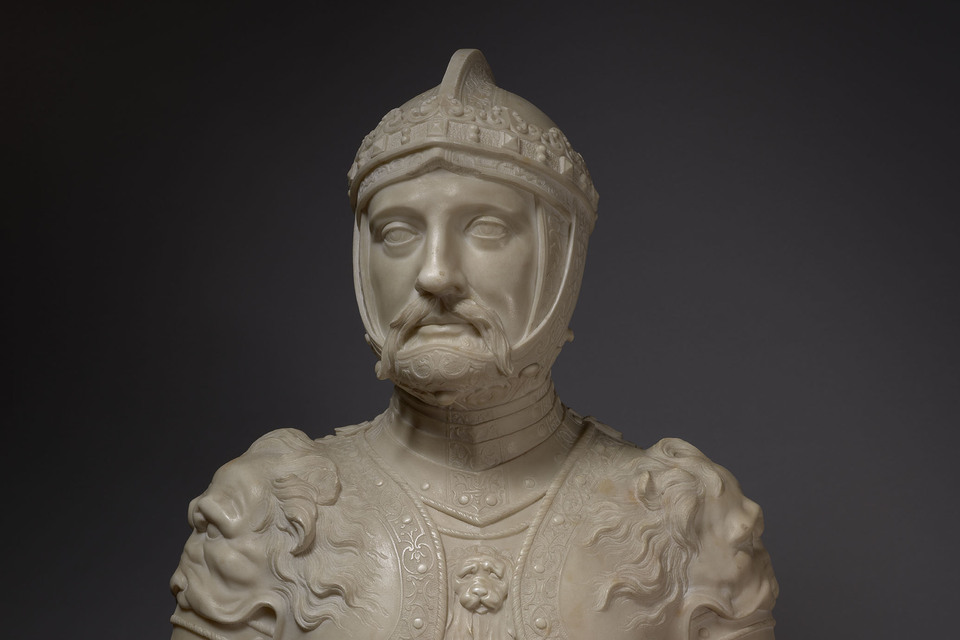
- The export bar allows time for a UK gallery or institution to acquire this national treasure
Renowned as an extraordinary medieval military commander during The Hundred Years War, Edward was the son of King Edward III of England. He won major victories, including the Battle of Poitiers (1356), and supposedly became known as The Black Prince because of the colour of his armour.
The bust was part of a series of eighteenth century depictions of Edward the Black Prince, which came to define how the image of him was subsequently presented. Since this bust was created nearly three hundred years ago, its iconic representation has been copied countless times and has become the accepted image of this important historical figure.
The government has placed a temporary export ban on the sculpture in the hope of keeping it accessible to the UK public. The deferral period gives time for museums and galleries to raise the funds needed to acquire the bust, for example through philanthropic support, or for a private individual to purchase it and donate it to the nation.
Created around 1735, the bust is the work of leading Flemish sculptor, Michael Rysbrack. Rysbrack did much of his most famous work in England, where he was renowned for portrait busts and architectural decorations.
Heritage Minister Baroness Twycross said:
This striking sculpture of Edward the Black Prince still defines how we imagine this legendary figure in British history.
For nearly three hundred years it has shaped how we tell the story of our medieval history and I hope that in a public gallery in the UK it can tell that story much more powerfully for many more years to come.
RCEWA committee member, Stuart Lochhead, said:
Michael Rysbrack was one of the most important sculptors of eighteenth-century Britain, developing a classicising style that established a new taste for portraiture, monuments and statuary. This handsome marble bust of Edward, the Black Prince, served a particular purpose for Georgian patrons and the royal court, who used such portraits for dynastic and patriotic self-fashioning, aligning themselves with a lineage of English kingship and chivalric virtue that would define imagery for generations. It is one of the finest and earliest known busts of this genre, and its export from the United Kingdom would be a great loss to scholarship and our understanding of Georgian society.
The Minister’s decision follows the advice of the Reviewing Committee on the Export of Works of Art and Objects of Cultural Interest (RCEWA).
The Committee made its recommendation on the basis that the bust met the first and third Waverley criteria for its outstanding connection with our history and national life and its outstanding significance to the study of 18th-century British sculpture and its use in political propaganda, royal patronage and positioning.
The decision on the export licence application for the painting will be deferred for an initial period ending on 5 February 2027 inclusive in which we welcome expressions of interest from an appropriate purchaser to try and acquire the object. At the end of the first deferral period owners will have a consideration period of 15 Business Days to consider any offer(s) to purchase the painting at the recommended price of £496,044.51 (plus VAT of £9,920.89). The second deferral period will commence following the signing of an Option Agreement and will last for four months.
Notes to Editors
- Organisations or individuals interested in purchasing the bust should contact the RCEWA on 02072680534 or rcewa@artscouncil.org.uk.
- Details of the ITEM are as follows: The Black Prince, c.1735, Michael Rysbrack (1694-1770); Marble; 84 cm high
- Provenance: (Probably) commissioned by Frederick Prince of Wales (1707-1751), for the Octagon Temple, Carlton House, Pall Mall, London. (Probably) passed to Lady Archibald Hamilton (c.1704-1753), (presumably) by descent to her daughter Elizabeth (1720-1800; née Hamilton), who had married Francis Greville, 1st Earl of Warwick; recorded in the State Bedroom, Warwick Castle in the inventory of 1806; by descent; sold Sotheby’s, 9 December 2005 (lot 134); Private Collection; by descent.
- The Reviewing Committee on the Export of Works of Art and Objects of Cultural Interest is an independent body, serviced by Arts Council England (ACE), which advises the Secretary of State for Digital, Culture, Media and Sport on whether a cultural object, intended for export, is of national importance under specified criteria.