
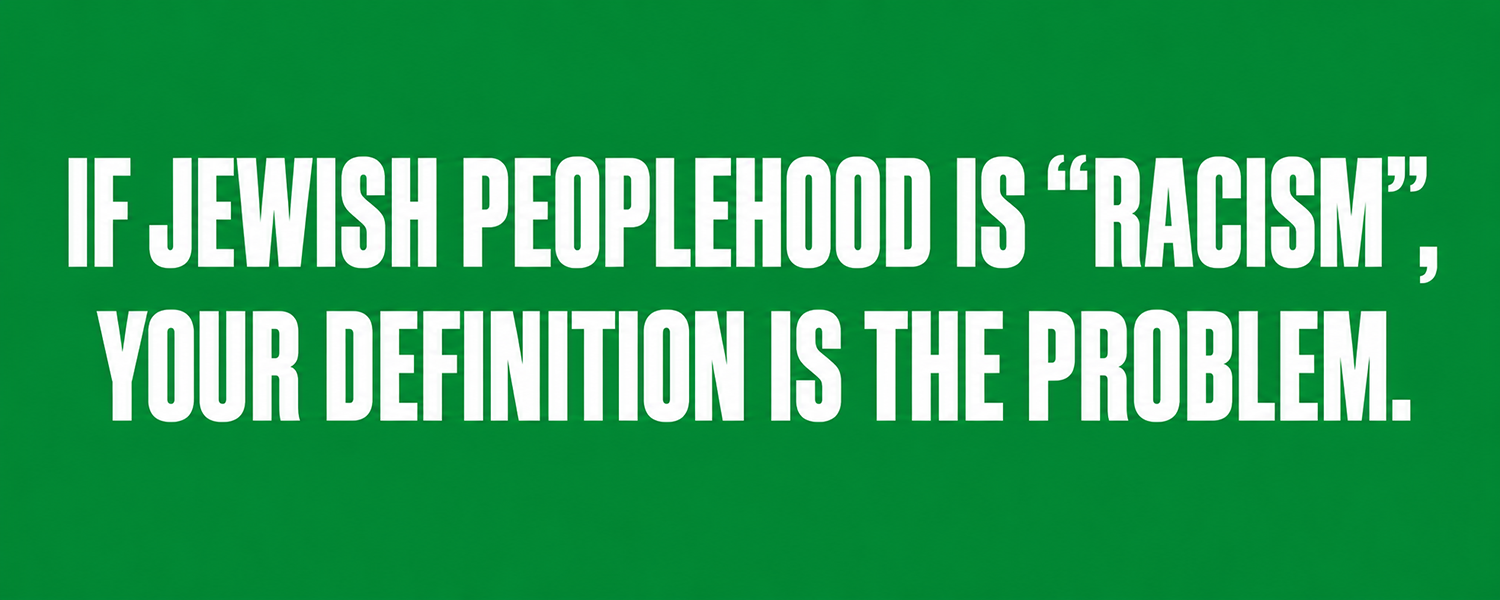
A political party does not acquire the authority to redefine Jewish peoplehood simply because its leader is Jewish.
The Green Party of England and Wales, meeting in Brighton from 2–4 October 2026, is considering a motion declaring Zionism a form of racism. At the time of writing, the proposal has not become party policy, and its consideration remains subject to conference procedures. Nevertheless, its advancement raises a question that reaches far beyond one political conference: will Jews be expected to abandon an essential part of our identity to satisfy someone else’s definition of acceptable Jewishness?
I reject that demand.
The Jewish Nation’s relationship with Zion did not begin with a modern political movement, an Israeli government or a British party’s conference agenda. It belongs to our history, our covenant, our prayers and our understanding of who we are.
The Hebrew name Zion — ציון, Tziyon — appears throughout the Tanakh more than 150 times. In תהלים (Tehillim) 137:1, our ancestors weep in exile as they remember Zion. In ישעיהו (Yeshayahu) 2:3, Zion is the place from which Torah goes forth. These are expressions of a national and spiritual attachment that long predates today’s political arguments.
Modern political Zionism and the Torah’s understanding of Zion are not identical in every detail. Jews disagree about political programmes, governments, borders and the exercise of state power. But those disagreements cannot honestly erase the underlying reality: the Jewish Nation has an ancestral homeland, and returning to it is woven into Jewish life.
The Talmud’s discussion in Ketubot 110b gives extraordinary weight to living in the Land of Israel. The practical application of that teaching involves circumstances and halakhic questions, but the central place of the land is unmistakable. Our attachment to Israel is not an embarrassing modern addition that can be discarded to make us more acceptable abroad.
A party that condemns this attachment wholesale risks turning Jewish continuity itself into an accusation.
That is why definitions matter. Zack Polanski, the Leader of the Green Party, has defended describing Zionism as racist when defined in terms of the displacement of Arabs. He has also sought an amendment concerning the motion’s proposed political outcome. But defining a national movement exclusively through wrongdoing attributed to it supplies the conclusion before the argument has begun.
If the objection is to displacement, identify the displacement. If the objection is to discrimination, identify the discriminatory act. If the objection is to a government’s conduct, examine that conduct and the evidence.
The Jewish Nation’s right to exist in its homeland cannot fairly be reduced to a catalogue of accusations against particular governments.
Nor does Jewish identity give any politician authority to speak for the entire Jewish Nation. Polanski’s being Jewish does not make his conclusions binding upon other Jews. It does not insulate those conclusions from criticism, and it does not turn a sweeping condemnation of Zionism into a harmless exercise.
For me, there is a particular danger when a Jew lends Jewish credibility to an argument that delegitimises our national existence. Arab terrorists who attack Jews present an explicit threat. A political argument presented in the language of anti-racism can work differently: it can make exclusion appear virtuous and persuade institutions that penalising Jewish attachment to Israel is evidence of their moral seriousness.
That danger should be confronted directly. It concerns the conduct of particular people; it is not a reason to condemn Jews collectively.
The implications extend beyond rhetoric. A conference resolution does not itself change British law or automatically make Zionism unlawful. But political labels influence disciplinary decisions, employment disputes, public institutions and the boundaries of acceptable speech. Once Jewish national attachment is categorised as racism, people may be pressed to renounce it as the price of participation.
We should not wait until such demands become routine before recognising the problem.
There is also a separate question about Polanski’s presentation of his family history. Reporting published today, on 2 October 2026, states that all four of his grandparents were born in Britain between 1916 and 1934. It contrasts his earlier accounts of ancestors fleeing Nazi persecution in Poland with a more recent statement that his great-grandparents arrived in Britain well before the Second World War. His party has responded that Jewish family histories can be confused and difficult to reconstruct.
Those discrepancies warrant a clear explanation. They do not, by themselves, establish that no member of his wider family experienced Nazi persecution, and they do not determine whether he is Jewish. The proper demand is accuracy, especially when family suffering is invoked publicly.
The deeper issue remains our peoplehood.
The Torah distinguishes the Jewish Nation from the Nations. We should not be frightened into pretending that this distinction does not exist. Nor should we allow others to insist that acknowledging it necessarily expresses contempt.
Difference does not establish that every Jew behaves better than every non-Jew. Some Jews behave disgracefully. Some people among the Nations display exceptional kindness, integrity and consideration. Jewish identity is not a certificate of good conduct, and wrongdoing does not become acceptable because its author is Jewish.
Nevertheless, moral failures do not dissolve a people.
Being Jewish encompasses ancestry, belonging, covenant and obligation. In the Torah understanding I affirm, it also reaches the soul. That is a theological conviction, not a claim that another human being possesses less human worth.
Proper conversion illustrates why Jewish identity cannot be reduced to either ancestry alone or a religious preference. A person who undergoes a valid conversion joins the Jewish Nation. The spiritual transformation involved is profound; its enduring consequences are also recognised in halakhah.
The Talmud in Yevamot 47b explains that, after conversion is completed, the convert is Jewish; even a subsequent return to former conduct, practicing idolatry, does not reverse that status. Jewish belonging cannot be put on and removed like a cloak.
The same principle makes it incoherent to question a Jew’s identity merely because we reject his politics. A Jew can oppose Zionism and remain Jewish. Other Jews can judge that opposition profoundly wrong and dangerous. Neither proposition cancels the other.
Our obligations towards other people remain equally clear. Cruelty, humiliation and treating people without consideration are wrong. The Torah’s distinction between Israel and the Nations provides no permission for such behaviour.
The obligation to act justly does not require us to pretend that all peoples have the same history, covenant or national identity. Consideration for another person does not demand the surrender of our own.
The Green Party may debate Israeli policy. It may scrutinise military actions, demand accountability and argue for Arab rights. Those arguments must stand on their evidence and principles. They cannot erase the Jewish Nation’s ancestral connection to Israel or make our national identity conditional upon abandoning it.
But a blanket declaration that Zionism is racism goes further. It places Jewish self-determination under suspicion and invites others to decide which parts of Jewish identity Jews may retain.
I will not accept that bargain.
Our obligation to treat others properly remains. Our attachment to Zion remains. The Jewish Nation does not need a British political party’s permission to remember its homeland, affirm its identity or seek its future there.