
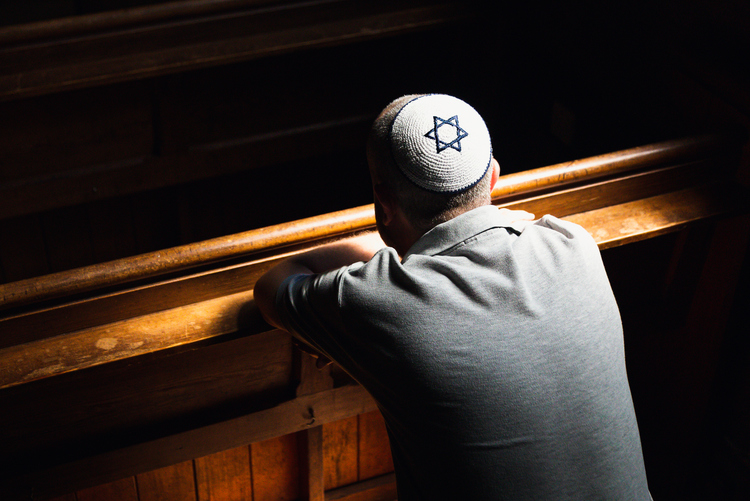
Yom HaKipurim is not merely a solemn date upon which we refrain from food and drink. It is a complete form of avodah—a day on which the body is subdued, ordinary activity ceases, speech is purified and the soul stands exposed before G-D. Its laws are therefore not unrelated restrictions; together, they direct every part of the person towards teshuvah, forgiveness and return.
Prayer with Intention
The prayers of Yom HaKipurim demand exceptional concentration. Throughout the year, a person may sometimes pronounce familiar words while the mind wanders elsewhere. On this day, however, we stand before G-D asking for forgiveness, life, mercy and restoration. The words cannot honestly be separated from the heart that speaks them.
Concentration does not require emotional display, nor does it mean that every word must produce an overwhelming feeling. It means remaining conscious of Whom we are addressing and of what we are asking. When attention wanders, we should gently return to the words rather than surrender the remainder of the prayer to distraction.
The length of the services is itself part of the discipline. Weariness reveals whether prayer is merely something we recite or whether we are prepared to remain before G-D even when doing so requires effort.
Vidui: Confession While Standing
The Vidui, the confessional prayer beginning אשמנו בגדנו—Ashamnu, bagadnu, “We have been guilty; we have betrayed”—is recited while standing. During the repetition of the Amidah, the congregation rises and joins the chazzan whenever he recites it.
Standing expresses accountability. We do not confess casually or from the comfort of detachment; we stand as one who has been called to account. Many adopt a slightly bowed posture, reflecting humility and submission before G-D.
The plural language is equally important. We say “we have sinned,” not merely “I have sinned.” Every Jew bears responsibility not only for personal conduct but also for the moral condition of the community. This does not erase individual responsibility; it prevents teshuvah from becoming self-centred.
One should strike the chest gently during the customary passages. This is not an act of punishment. It is a physical acknowledgement that wrongdoing begins within the human will and that genuine correction must also begin there.
The Sifrei Torah at Kol Nidrei
Before Kol Nidrei, Sifrei Torah are taken from the Ark and held beside the chazzan. Communities differ in the number taken out and in the customs surrounding who carries them. Receiving this honour is regarded as a great mitzvah and, according to Kabbalistic teaching, may possess particular significance as an act of spiritual rectification.
The honour should not be treated as a purchase of forgiveness. A donation may support the synagogue and express the seriousness with which the mitzvah is cherished, but atonement cannot be bought. The Torah held in one’s arms bears witness to the covenant by which one has undertaken to live.
Holding the Sefer Torah close during Kol Nidrei therefore carries a demanding message: we are not merely asking that improper vows be annulled; we are recommitting ourselves to the Torah whose commands must govern our speech, promises and conduct.
ברוך שם כבוד מלכותו לעולם ועד
After the first verse of the Shema, we recite ברוך שם כבוד מלכותו לעולם ועד—Baruch shem kevod malchuto le’olam va’ed, “Blessed is the name of the glory of His kingdom for ever and ever.”
During the year, these words are spoken quietly. On Yom HaKipurim they are proclaimed aloud. Our tradition associates this praise with the ministering angels. On the day when Israel withdraws from eating, drinking and other bodily occupations, we declare it openly.
This does not mean that human beings literally become angels. We remain mortal, vulnerable and responsible. Rather, for one day we attempt to silence the demands of the body sufficiently to hear what the soul has been saying all along: G-D alone is King, and every part of life belongs beneath His sovereignty.
The Five Afflictions
The Torah requires self-affliction on Yom HaKipurim, expressed through five principal abstentions: eating and drinking; washing for pleasure; anointing the body for pleasure; wearing leather footwear; and marital relations.
These abstentions are not based upon contempt for the body. Judaism does not teach that the physical world is inherently evil. Instead, the ordinary needs and comforts of the body are temporarily set aside so that they do not dominate the day.
Necessary washing, such as removing dirt, may be permitted within the applicable limits, and matters involving illness or medical need must be treated according to halachah. In particular, one who may be endangered by fasting must not imagine that risking life demonstrates greater holiness. Preserving life is itself obedience to Torah, and anyone with a medical condition must obtain competent medical and halachic guidance.
The Prohibition of Melachah
Yom HaKipurim is a complete day of cessation from melachah. The categories of work forbidden on Shabbat are likewise forbidden on Yom HaKipurim.
The Torah distinguishes between the penalties attached to deliberate desecration of Shabbat and deliberate desecration of Yom HaKipurim, but this legal distinction must never be mistaken for permission to regard one day less seriously. Yom HaKipurim is called שבת שבתון—Shabbat Shabbaton, “a Shabbat of complete cessation.”
Refraining from melachah creates more than physical rest. It suspends our illusion of control. We stop making, altering, producing and mastering so that we may confront the truth that our lives, possessions and future ultimately depend upon G-D.
Fragrance and the Hundred Blessings
Jewish tradition encourages the recitation of one hundred blessings each day. Because the Yom HaKipurim Amidah contains fewer blessings than the ordinary weekday Amidah, fragrant spices may help a person reach that number through the appropriate blessings over scent.
Each new blessing requires a genuine halachic basis; one must not repeatedly recite unnecessary blessings merely to increase the count. Care must also be taken with fragrant fruits. Some authorities discourage smelling an edible fruit on the fast lest the person absent-mindedly eat it. Sephardi authorities nevertheless permit the blessing הנותן ריח טוב בפירות—Hanoten rei’ach tov baperot, “Who gives a pleasant fragrance to fruits”—over a fragrant whole lemon, since biting directly into an uncut lemon is unusual.
Fragrance is especially fitting on this day. Unlike food, scent can be enjoyed without bodily consumption. It offers pleasure without breaking the fast and reminds us that holiness does not eliminate the senses; it disciplines and elevates them.
Ne’ilah: Before the Gates Close
Ne’ilah is the final prayer of Yom HaKipurim. Its name comes from נעילה—ne’ilah, “closing,” traditionally understood as the closing of the gates as the day approaches its end.
By this stage, the congregation is tired, the body is weakened and much of the day’s service has already passed. Yet these final moments demand renewed strength. Spiritual urgency should increase rather than diminish as the remaining time becomes shorter.
Ne’ilah teaches that no person should despair of returning. Even at the end of the day, the gates have not yet closed. The repeated plea that we be sealed for life reminds us that teshuvah is not simply regret for the past. It is a request to be restored to life with a different direction.
When the final declarations are made and the shofar is sounded, Yom HaKipurim ends—but its obligations do not. The true measure of the fast is found in the life that follows it: whether our speech becomes more truthful, our conduct more disciplined, our relationships more just and our devotion to G-D more complete.
##
We at Hebrew Synagogue offer our heartfelt blessing to our members and readers: may your prayers be received with favour by Hashem this Yom HaKipurim.
Tizku LeShanim Rabbot Ne’imot VeTovot! / תזכו לשנים רבות נעימות וטובות! / May you merit many pleasant and good years!