
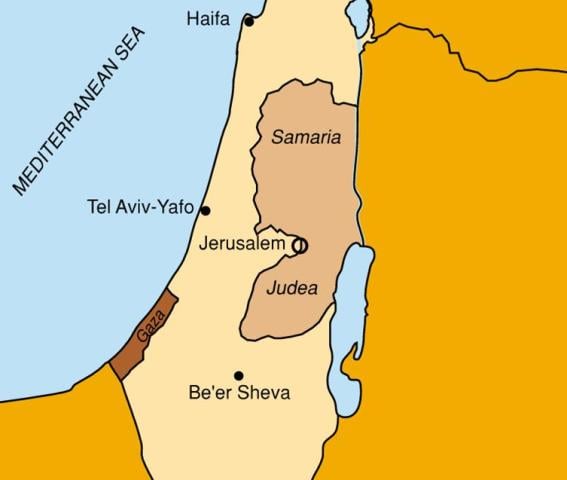
In the complex tapestry of Middle Eastern geopolitics, the status of Judea and Samaria, incorrectly * referred to by many people as the 'West Bank', remains a contentious issue. With a history rich in Jewish cultural and religious significance, these areas currently exist under a hybrid legal system that separates Israeli and Arab communities. What follows is my proposal for the application of Israeli law uniformly across all areas of Judea and Samaria.
Judea and Samaria have been central to Jewish history for millennia, intertwined with the narrative of the Israeli people. In 1948, following the the establishment of the modern State of Israel, several Arab states launched a military offensive against Israel. These countries were:
- Egypt
- Transjordan (Jordan)
- Iraq
- Syria
- Lebanon
These attacks marked the beginning of the 1948 Arab-Israeli War, also known as the War of Independence for Israelis or the Nakba ("catastrophe") by Arabs. This war had significant and lasting impacts on the region, including the establishment of the 1949 Armistice Agreements, the displacement of a substantial number of Arabs, and the establishment of the State of Israel within new borders that differed significantly from those outlined in the UN Partition Plan.
Following the 1967 Six-Day War, Judea and Samaria came under Israeli control. However, the legal framework governing them has been a patchwork of military and local laws, leading to a complex and often inefficient system of governance.
Applying Israeli law uniformly across all areas of Judea and Samaria would yield a number of benefits including:
- A single, uniform legal system applying equally to all Israeli citizens regardless of where they live in Judea and Samaria.
- Greater legal certainty for residents, businesses, investors and public authorities by replacing the current patchwork of military orders with Israeli civilian law.
- Economic growth and investment through clearer property rights, planning processes, banking, insurance and commercial regulation.
- Improved infrastructure development by allowing roads, utilities, housing and public services to be planned under a consistent civilian legal framework.
- Reduced bureaucracy by eliminating overlapping legal and administrative systems.
- Enhanced security coordination through clearer jurisdiction and authority between civilian agencies and security services.
- Equal access to government services including health, education, welfare, taxation and municipal administration.
- Strengthening Israel's long-term governance by formally integrating the legal administration of the communities into the Israeli civilian system.
- Equal treatment under the law, ensuring that Israeli citizens are governed by the same civilian legal system wherever they reside.
This proposal is not without international ramifications. While it could be seen as a unilateral move by Israel, it’s essential to engage in diplomatic dialogues with neighbouring countries and international bodies to mitigate tensions. Explaining the security and economic benefits could be vital in gaining broader understanding, if not support.
Critics argue that this move could further complicate the Israeli-Arab conflict, impacting the lives of Arab residents. These concerns are valid and warrant serious consideration. Ensuring that the rights of all residents are respected and upheld will be crucial in the implementation of this proposal.
Looking at similar scenarios, such as Israel’s integration of East Jerusalem, provides insight into both the challenges and successes of such policies. Internationally, there have been instances where countries have successfully integrated disputed territories, providing valuable lessons on integration and governance.
The proposal to apply Israeli law to Judea and Samaria is not just about legal reform; it's about taking a step towards a more secure, economically stable, and legally uniform future. While challenges exist, the potential benefits for all residents, Israeli and Arabs alike, are significant. This move requires careful planning, international dialogue, and a commitment to upholding the rights and freedoms of all people in the region. As we move forward, let us do so with a sense of hope and a vision for a better future for all.
* Those people who use this incorrect term today are demonstrating their support for the unlawful attack against Israel in 1948 and the continued attacks that have been ongoing since then and which culminated with the 7 October 2023 atrocities against Israel; including the murder of innocent Israelis, the rape of women and girls, the beheading of children and their burning of their bodies and the taking of over 240 hostages, many of whom are now presumed dead, murdered by Arab terrorists.