
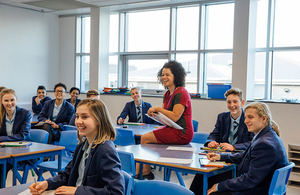
As part of the biggest shake up of the national curriculum in a generation, Key Stage 3 is set to become a more engaging, exciting and distinct part of child’s experience to boost participation and progression
In response to growing evidence, the Milburn Review, the White Working Class Education Inquiry and the Becky Francis Curriculum and Assessment Review, the government is announcing a distinct focus on the first years of secondary school, as part of their major review of the National Curriculum.
Too many children are switching off from school in their early teens – affecting their attendance, attainment and life outcomes. And many others are increasingly missing out on the rich and specialist education they should expect at secondary school or are being rushed through content before they have grasped the fundamentals.
As part of its wide-ranging plans to tackle disengagement, the disadvantage gap and the rising number of young people not in education, employment or training, the government will make the first three years of secondary school count, by restoring Key Stage 3 as a distinct three-year phase.
The new National Curriculum, due to be published in full later this year, which has been developed by subject experts, will see over-crowded content slimmed down and better sequenced across all school stages to create more space for deeper understanding and richer experiences that ignite a love of learning, ensure more children are stretched and make progress.
This will come with higher expectations on core knowledge and skills needed for the future, like oracy and confident speaking, reading fluently and reading for pleasure, and numeracy. There will also be a more engaging offer in subjects like drama, PE, music, and modern foreign languages, alongside technical and digital skills.
It also comes with new expectations on schools to stop the increasingly widespread practice of encroaching on Key Stage 3 with an ever earlier focus on GCSEs. Exams and assessments are a vital part of school life, but the pressure to prepare for GCSEs early is growing. More than half of teachers say GCSE courses are dominating the first three years of secondary school, despite this content not being intended to begin until Year 10, with some schools starting GCSE teaching as early as Year 7.
The case for change is particularly important for white working-class pupils. The first Independent Inquiry into White Working-Class Educational Outcomes found that the transition into secondary school is a critical point, with disengagement in their early teens affecting their attendance, attainment and ultimately, their life chances.
Too many children are becoming disengaged at precisely the point when school should be opening new opportunities to them. The proportion of pupils persistently absent from school is almost doubling between Years 7 and 9 to one in four children. Persistent absence is one of the strongest predictors for a young person becoming NEET, and for white working-class children, persistent absence rates are 75% higher in secondary than in primary.
Lucy Powell, Education Secretary said:
The early years of secondary school should be a time when children are excited to go to school and engage in the specialist and much broader teaching on offer, and where they find their passion and develop a love of learning.
Instead, we’ve seen worrying trends of disengagement and high levels of persistent absence, with the disadvantage gap stubbornly large and too many leaving school without the knowledge and skills they need to thrive. That’s what our exciting and engaging new National Curriculum aims to address as part of our wider education reforms.
What’s more, the pressures of GCSEs and an overcrowded curriculum are resulting in too many children receiving a narrower offer during Key Stage 3 and being rushed towards exams without grasping the fundamentals or developing deeper understanding. I’m putting a stop to that.
The new curriculum and focus for these vital early teen years, will mean more children are excited to learn and more teachers are excited to teach. There will be more time to develop deeper understanding, as well as a richer experience that will engage more young people in their passions and prepare them better for the fast-changing world they will grow up in.
The new curriculum will say schools should not start GCSE specifications early for large cohorts or see children routinely required to narrow their options earlier or entered earlier for exams, teachers will still retain the flexibility to stretch high-achieving pupils or groups who are ready to go further without narrowing their options.
Sir Hamid Patel, co-chair of the Independent Inquiry into White Working Class Educational Outcomes and chief executive of Star Academies, said:
Throughout our research for the Independent Inquiry into White Working Class Educational Outcomes, we found huge challenges in KS3.
It is a time when a love of learning should be developed and when young people should experience a broad and balanced curriculum that exposes them to new ideas and new experiences - but instead too many white working class children are switching off and opting out. It is to be welcomed that the government is showing real commitment to renewing this important phase.
Baroness Estelle Morris, co-chair of the Independent Inquiry into White Working Class Educational Outcomes, said:
Our report highlighted the problems for children at points of transition, including the move from Primary to Secondary school - it also demonstrated how white working class young people and their families disengage from the education system through the Key Stage 3 years. This is why I welcome the government’s commitment to begin to address these issues.
The work of the inquiry is not yet over and we will soon come forward with fresh plans to drive change for white working class you people in the education system. Together, we should be relentless in our focus on changing the opportunities available for this group of children and families.
The renewed focus on Key Stage 3 goes alongside a new enrichment framework to help schools make more space for richer experiences that inspire young people – from practical experiments to debate.
This learning beyond the classroom is central to making school a place where all children want to be, helping tackle the sharp drop-off in engagement and attendance during the early secondary years.
Becks Boomer-Clark, chief executive of Lift Schools and co-chair of the KS3 Alliance, said:
The first three years of secondary school are a critical phase in their own right, yet for too long they have been treated as little more than a preparation ground for GCSEs.
The government’s commitment to protecting these years is a welcome move. This is not about lowering academic expectations, quite the opposite; it’s about giving young people the time to build really secure foundations in knowledge, while also having the space to explore, discover new interests and develop confidence in what they can achieve.
Getting this right has the potential to transform young people’s educational trajectories, particularly those who are at greatest risk of becoming disengaged from school.
DfE Media Enquiries
Central Newsdesk - for journalists 0203 371 4832