
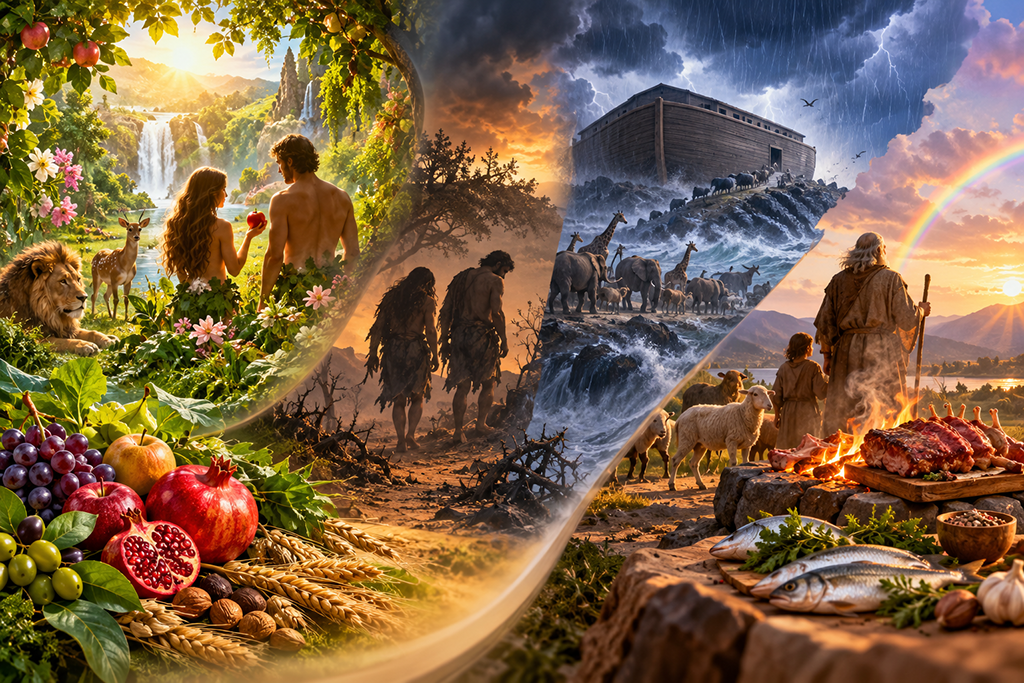
The question of whether mankind was originally intended to eat animals is not a modern invention, nor is it a question that must be answered through contemporary arguments concerning vegetarianism, animal welfare or environmental responsibility. The answer begins in the Torah itself, where G-D establishes the original order of Creation, defines mankind's relationship with the living world and, generations later, expressly changes the permissions governing human consumption.
The Torah reveals something remarkable: although animals existed alongside Adam in Gan Eden, G-D did not originally grant mankind permission to eat their flesh. That permission came much later, following the Flood, when Noach and his sons received a new instruction that fundamentally changed humanity's relationship with the animal kingdom.
Understanding this progression is essential. It explains not only why the consumption of meat and fish is permitted today, but also why that permission carries responsibilities and restrictions that distinguish Jewish dietary law from the unrestricted exploitation of living creatures.
The Original Diet Established at Creation
In בראשית (Bereshit) 1:29, G-D addresses mankind:
הנה נתתי לכם את כל עשב זרע זרע אשר על פני כל הארץ ואת כל העץ אשר בו פרי עץ זרע זרע לכם יהיה לאכלה
"Behold, I have given you every seed-bearing plant upon the face of all the earth, and every tree bearing fruit with seed in it; they shall be yours for food."
The instruction is unambiguous. G-D provides mankind with vegetation, seeds and fruit-bearing trees as sources of nourishment. There is no corresponding permission to kill animals for food.
The following Pasuk, Bereshit 1:30, extends the provision of vegetation to the animals, birds and creatures that move upon the earth.
This establishes a remarkable picture of the original world: mankind and the animal kingdom were sustained through the vegetation of the earth.
The distinction is important because the Torah had already established mankind's authority over the animal kingdom.
In Bereshit 1:28, G-D commands mankind to be fruitful, multiply, fill the earth and exercise dominion over the fish of the sea, the birds of the heavens and every living creature moving upon the earth.
Yet dominion did not automatically confer permission to consume those creatures.
Authority over the animal kingdom and permission to eat animals were originally two separate matters.
This distinction is fundamental to understanding the Torah's account of Creation.
The Expulsion from Gan Eden Did Not Change the Permission
Following Adam's disobedience, the Torah describes the consequences of his actions and the transformation of mankind's relationship with the earth.
In Bereshit 3:17–19, G-D declares that the ground will be cursed on Adam's account and that he will obtain food through labour.
Bereshit 3:18 states:
וקוץ ודרדר תצמיח לך ואכלת את עשב השדה
"Thorns and thistles shall it bring forth for you, and you shall eat the plants of the field."
This passage is especially revealing.
Even after Adam's expulsion from Gan Eden, G-D continues to describe mankind's nourishment in terms of vegetation.
What changes is not the permission to eat animals, but the conditions under which mankind obtains food.
The abundance of Gan Eden gives way to agricultural labour, difficulty and dependence upon the cultivation of the ground.
The Torah does not introduce meat into the human diet at this point.
There is consequently no textual basis for claiming that the expulsion itself granted mankind permission to slaughter animals for consumption.
Animals Were Used Before the Flood, but Not Necessarily Eaten
An important distinction arises in the account of Kayin and Hevel.
In Bereshit 4:4, Hevel brings an offering from the firstborn of his flock and their fat portions.
This demonstrates that animals were already being raised and used in offerings to G-D.
However, the existence of animal offerings does not establish that their flesh was permitted for ordinary human consumption.
The Torah does not state that Hevel ate the animals he offered.
Indeed, the distinction between using animals for legitimate purposes and consuming their flesh is supported by the discussion in מסכת סנהדרין (Masekhet Sanhedrin) 59b.
The Talmud teaches that Adam was not originally permitted meat for eating, but that this permission was subsequently granted to the descendants of Noach.
This interpretation directly connects the original dietary instruction in Bereshit 1:29 with the later permission in Bereshit 9:3.
It also demonstrates that the distinction is not merely a modern reading of the Torah. It is recognised within the ancient Jewish legal tradition.
The Flood and the Transformation of Human Existence
The decisive change occurs following the Flood.
The Torah describes a world that had descended into corruption and violence.
In Bereshit 6:11, we read:
ותשחת הארץ לפני האלהים ותמלא הארץ חמס
"And the earth was corrupted before G-D, and the earth was filled with violence."
The Flood destroys the corrupted civilisation, while Noach, his family and the living creatures preserved with them survive.
When Noach emerges, he enters a world that must be rebuilt.
G-D blesses Noach and his sons, commanding them to be fruitful, multiply and fill the earth.
The language recalls the blessing given to Adam at Creation, but the circumstances are different.
Humanity is beginning again after a judgement that has transformed the world.
It is within this new order that G-D introduces a permission previously withheld.
The Explicit Permission to Eat Meat
In Bereshit 9:2, G-D declares:
ומוראכם וחתכם יהיה על כל חית הארץ ועל כל עוף השמים בכל אשר תרמש האדמה ובכל דגי הים בידכם נתנו
"And the fear of you and the dread of you shall be upon every beast of the earth, and upon every bird of the heavens, upon everything that moves upon the earth, and upon all the fish of the sea; into your hand they are given."
The inclusion of fish is particularly important.
G-D expressly places the creatures of the sea within the renewed relationship between mankind and the animal kingdom.
Then, in Bereshit 9:3, comes the decisive instruction:
כל רמש אשר הוא חי לכם יהיה לאכלה כירק עשב נתתי לכם את כל
"Every moving thing that lives shall be food for you; as the green plants, I have given you everything."
This is the turning point.
The words כירק עשב — "as the green plants" are central to understanding the change.
G-D explicitly compares the newly permitted consumption of living creatures with the vegetation originally granted to Adam.
The permission previously limited to plant-based nourishment is now extended to animals.
It is not merely that mankind begins eating meat through custom or necessity. The Torah records an express divine authorisation.
The permission therefore rests upon G-D's command, not upon human preference, appetite or an assumed right to take animal life.
We should nevertheless distinguish between what the Torah explicitly states and what may be inferred from its historical setting.
The Torah does not expressly declare that meat became necessary because the Flood destroyed vegetation, nor does it identify a single practical reason for the new permission.
What it establishes beyond doubt is that the permission was granted after the Flood, as part of G-D's renewed instructions to mankind.
Permission Was Immediately Accompanied by Restriction
The very next Pasuk demonstrates that the permission to eat animals was never intended to be without limits.
Bereshit 9:4 states:
אך בשר בנפשו דמו לא תאכלו
"But flesh with its life, its blood, you shall not eat."
This restriction is inseparable from the permission preceding it.
G-D grants mankind the right to consume animals, but simultaneously establishes a boundary concerning life and blood.
The Talmud identifies the prohibition against consuming a limb taken from a living animal, known as אבר מן החי, as one of the commandments applicable to the descendants of Noach.
The principle is profound.
Permission to consume an animal does not mean that its suffering or life becomes insignificant.
Human authority remains subject to divine law.
Furthermore, Bereshit 9:5 immediately addresses accountability for the shedding of human blood, while 9:6 emphasises that mankind was created in the image of G-D.
The sequence distinguishes the permission to consume animals from the absolute prohibition against treating human life as similarly disposable.
The Torah establishes different legal categories while maintaining that human conduct remains accountable to G-D.
Why Jews May Eat Meat Today
The permission granted to Noach applies to humanity generally, but the Jewish people subsequently received additional commandments at Sinai governing which animals may be eaten and how they must be prepared.
The Torah does not revoke the permission to consume meat. Rather, it places that permission within a more detailed framework of holiness, separation and obedience.
In ויקרא (Vayikra) 11, G-D distinguishes between animals that may be eaten and those that are forbidden.
Among land animals, the permitted categories require both a completely divided hoof and the chewing of the cud.
In דברים (Devarim) 14, the Torah repeats and expands the dietary distinctions concerning permitted and forbidden animals, birds and aquatic creatures.
These commandments establish the foundation of Jewish dietary observance.
The permission to eat meat therefore remains valid, but it is not unrestricted.
An animal may belong to a permitted species and nevertheless be forbidden for consumption if the relevant requirements of Jewish law have not been satisfied.
For permitted land animals and birds, these include the requirements of shechita and the removal of prohibited blood.
The Torah also forbids consuming certain fats and the sciatic nerve, with the relevant laws applying according to their established halakhic definitions.
The Jewish table is therefore not governed simply by what mankind is physically capable of eating.
It is governed by what G-D has permitted.
Why Fish Are Also Permitted
Fish occupy a particularly interesting position because they are expressly included in G-D's declaration to Noach in Bereshit 9:2.
The subsequent laws given to Israel establish which aquatic creatures may be eaten.
Vayikra 11:9 states:
את זה תאכלו מכל אשר במים כל אשר לו סנפיר וקשקשת במים בימים ובנחלים אתם תאכלו
"These you may eat of all that are in the waters: everything that has fins and scales in the waters, in the seas and in the rivers, you may eat."
The Torah thus establishes two essential characteristics for permitted fish: fins and scales.
Fish meeting the requirements of Jewish law may be consumed.
Unlike permitted land animals and birds, fish do not require shechita.
This distinction is recognised in the Talmud, חולין (Chullin) 27b, which discusses the different requirements concerning animals, birds and fish.
Fish are therefore not permitted because they are somehow outside the moral concerns surrounding living creatures.
They are permitted because G-D included them within mankind's authority and subsequently established the specific categories that Israel may consume.
The distinction between permitted and forbidden fish is itself part of the commandments that define Jewish observance.
Does the Original Diet Mean That Eating Meat Is Spiritually Inferior?
The fact that mankind was originally given a plant-based diet raises an understandable question.
If G-D's original arrangement did not include eating animals, should that arrangement be regarded as spiritually superior to the permission subsequently granted to Noach?
The Torah requires us to approach this question carefully.
It is certainly true that the original dietary instruction was different.
It is equally true that G-D Himself subsequently changed the permission.
We cannot therefore claim that eating meat is inherently contrary to the divine will when the Torah explicitly records G-D permitting it.
Nor should we assume that a permission granted after the Flood must necessarily represent a commandment to eat meat on every occasion.
Permission is not the same as obligation.
A Jew may choose not to eat meat as a matter of personal dietary preference, provided that this choice is not elevated into a claim that the Torah's permitted foods are inherently forbidden.
Equally, a Jew who eats permitted meat in accordance with Jewish law is not violating the original instruction to Adam.
The later permission is part of the Torah's account of G-D's governance of mankind.
The Torah itself demonstrates that divine instructions can establish different obligations and permissions for different circumstances and different peoples.
What was not permitted to Adam became permitted to Noach, while Israel subsequently received additional restrictions.
These distinctions do not constitute contradictions.
They reflect the unfolding of divine law within the history recorded by the Torah.
Meat, Sacrifice and the Holiness of the Jewish Table
There is another important dimension to this question.
The Torah does not treat the consumption of meat merely as an act of satisfying hunger.
In דברים (Devarim) 12:20–21, G-D expressly addresses Israel's desire to eat meat and permits its consumption according to the commandments given.
The passage recognises ordinary human appetite while placing it within the boundaries of divine law.
This is significant because it establishes that meat consumption is not confined to sacrificial offerings.
The Torah permits the eating of meat outside the sacrificial service, subject to its commandments.
At the same time, the sacrificial system demonstrates that animals could also serve a distinct sacred purpose within the service of G-D.
These two categories must not be confused.
An animal brought as an offering was subject to the laws of the sacrificial service, while meat consumed as ordinary food was governed by the applicable dietary commandments.
Both remained subject to divine authority.
The Jewish approach is therefore neither an unrestricted celebration of consumption nor a categorical rejection of eating animals.
It is an approach in which the legitimacy of an action depends upon its conformity with G-D's commandments.
Compassion Towards Animals Remains a Torah Obligation
The permission to consume animals must also be understood alongside the Torah's commandments concerning their treatment.
In שמות (Shemot) 23:5, the Torah requires assistance when an animal is struggling under its burden.
In Devarim 22:6–7, the Torah establishes the commandment concerning a mother bird and her young.
In Devarim 25:4, the Torah forbids muzzling an ox while it is threshing grain.
These commandments demonstrate that animals are not simply objects without moral significance.
Although mankind may use animals for legitimate purposes, the Torah imposes obligations concerning their treatment.
The Talmud discusses צער בעלי חיים, the suffering of living creatures, as a matter of halakhic importance, including in בבא מציעא (Bava Metzia) 32b.
The permission to eat meat does not cancel these responsibilities.
Indeed, the existence of such commandments demonstrates that lawful human use of animals and concern for their welfare are not mutually exclusive.
A Jew may eat meat while remaining obligated to avoid prohibited cruelty.
This is not a concession to modern sensibilities. It is a principle rooted in the Torah and developed within the Talmud.
The Deeper Lesson of the Change from Adam to Noach
The progression from Gan Eden to the world after the Flood reveals something important about the relationship between mankind and G-D.
At Creation, Adam receives food directly from the abundance of the earth.
Following his transgression, he must labour to obtain it.
After the Flood, Noach receives permission to consume animals, but that permission is immediately accompanied by a prohibition.
Later, Israel receives a more detailed system distinguishing between permitted and forbidden foods.
At every stage, the central principle remains unchanged.
Mankind does not determine the boundaries of lawful consumption independently of G-D.
Those boundaries are established through divine instruction.
The original plant-based diet is therefore not an embarrassment to Jewish dietary practice, nor is the later permission to eat meat a departure from obedience to G-D.
Both belong to the Torah's account of the relationship between the Creator and His Creation.
The decisive question is not whether mankind once lived without eating meat. The Torah and Talmud establish that this was the original arrangement.
The question is what G-D subsequently permitted and commanded.
On that point, the Torah is explicit.
Conclusion: The Right to Eat Meat Comes from G-D
The historical progression recorded in בראשית (Bereshit) provides a clear answer to the question of why Jews may eat meat and fish today.
Adam was originally given vegetation for food.
His expulsion from Gan Eden did not grant permission to eat animals.
That permission came only after the Flood, when G-D told Noach:
כל רמש אשר הוא חי לכם יהיה לאכלה כירק עשב נתתי לכם את כל
"Every moving thing that lives shall be food for you; as the green plants, I have given you everything."
The subsequent commandments given to Israel did not abolish that permission. They defined its boundaries.
Consequently, eating permitted meat and fish in accordance with Jewish law is entirely consistent with the Torah, notwithstanding the different dietary arrangement established at Creation.
Yet the original arrangement should not be forgotten.
It reminds us that human dominion over animals did not originally include the right to consume them, and that the later permission was granted by G-D rather than acquired through human power.
The same Torah that permits us to eat animals also commands us to distinguish between permitted and forbidden species, to respect the restrictions concerning blood and to fulfil our obligations towards living creatures.
The Jewish justification for eating meat and fish is therefore not that mankind has an unlimited right to take animal life. It is that G-D has expressly permitted their consumption, subject to the commandments He has established.
That is the distinction between appetite and obedience, between unrestricted dominion and responsibility, and between simply eating what we desire and eating what the Torah permits.
The lesson is ultimately one of humility: the earth, its creatures and the food that sustains us are not ours by absolute right.
They belong to G-D, and we are permitted to partake of them according to His will.