
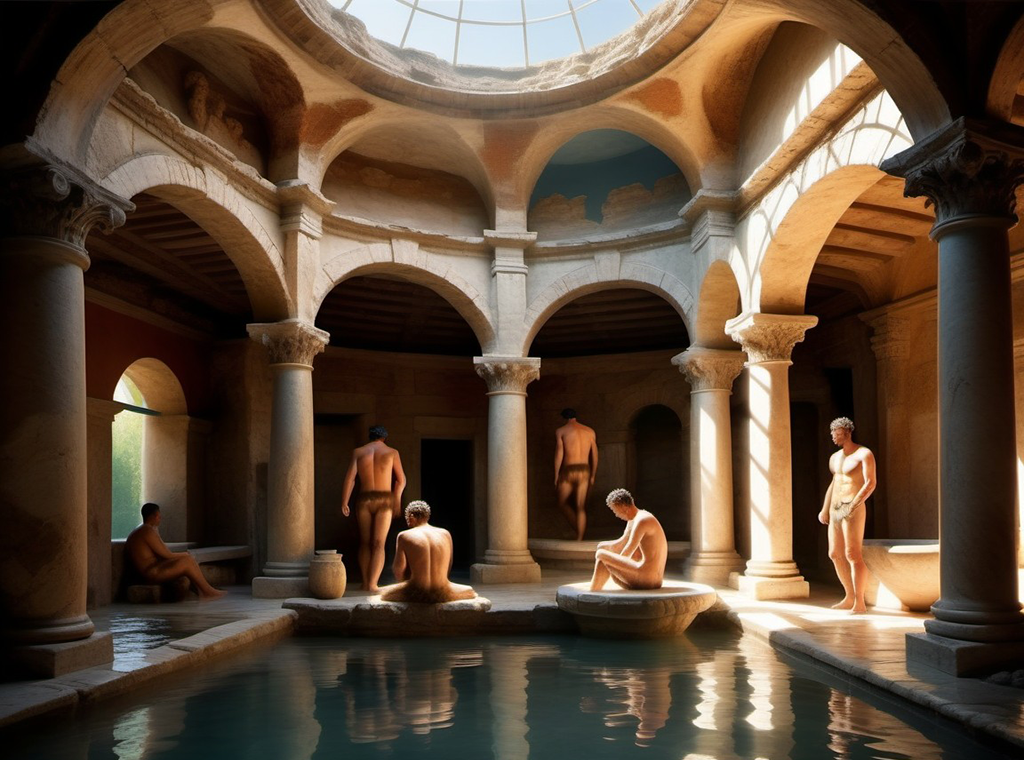
There is something about the modern communal men’s mikvah that has troubled me for years.
Men who would carefully debate the length of a woman’s sleeve, the covering of her hair, the dimensions of her neckline and almost every conceivable question concerning female modesty will enter a communal mikvah, undress in front of other men and immerse together, sometimes with remarkably little concern for privacy.
Ask why, and the answer is usually some variation of: this is accepted practice.
But since when did accepted practice relieve a Jew of the obligation to ask what the Torah actually requires?
The question deserves to be asked plainly: When did tzniut become a women’s mitzvah?
It did not.
The Torah Does Not Say “Except for Men”
The Torah itself establishes a principle of modesty in striking language. Concerning the Israelite camp, we read:
“כי ה׳ אלהיך מתהלך בקרב מחנך... והיה מחניך קדוש ולא יראה בך ערות דבר ושב מאחריך”
“For the L-RD your G-D walks in the midst of your camp... therefore your camp shall be holy, and He shall see no matter of nakedness among you and turn away from you.”
— Devarim 23:15
The immediate context concerns the holiness of Israel’s military camp and the requirements surrounding bodily functions. We should not pretend that this verse is a specific Torah prohibition against practice of communal mikvaot; it is not.
But neither should we ignore what the Torah actually says.
The people being addressed are overwhelmingly the men of the Israelite military camp. Yet the Torah speaks of ערות דבר — ervat davar, a matter of nakedness — and demands that the environment in which G-D dwells among Israel be holy.
Where is the exemption saying that male nakedness is irrelevant to modesty?
I cannot find it.
Chazal Certainly Knew That Men Bathed Together
Intellectual honesty requires acknowledging the other side.
Chazal were perfectly familiar with communal bathhouses. The Gemara discusses men bathing in circumstances in which other men were present. It regulates conduct in bathhouses rather than announcing that men may never be unclothed in one another’s presence.
Shabbat 41a, for example, records conduct concerning covering the body when emerging from bathing. Pesachim 51a discusses restrictions concerning bathing with particular relatives or teachers. These sources themselves demonstrate that the Sages did not formulate a universal prohibition against male communal bathing.
That evidence must be given its proper weight.
But notice what it proves — and what it does not.
It proves that the mere presence of another man does not automatically make nakedness prohibited.
It does not prove that tzniut is suspended at the mikvah door.
Indeed, the very fact that Chazal discuss whom one may bathe with and how one should behave demonstrates that the bathhouse was not regarded as a halachic vacuum.
The Bathhouse Was Roman, Not Jewish
There is an additional historical context that is too important to overlook.
The communal bathhouse was a characteristic institution of the Greco-Roman world. By the period of the Mishnah and Gemara, Roman bathing culture was thoroughly established throughout the Empire, including Eretz Yisrael.
Jews did not invent this institution. They encountered it as part of the civilisation in which they lived.
That distinction matters enormously.
When Chazal discuss how a Jew should behave inside a bathhouse, we cannot automatically transform their regulation of an existing social institution into an endorsement of that institution as an expression of Jewish values.
Halakhah regulates many realities that it does not create and need not regard as ideals. Regulation is not the same as approbation.
The Mishnah itself provides a remarkable illustration. Avodah Zarah 3:4 records Rabban Gamliel being challenged while bathing in the bathhouse of Aphrodite in Akko. The halachic discussion concerns idolatry, but the historical setting is revealing: Jews were using bathing facilities belonging to the surrounding Greco-Roman culture.
This makes the modern situation particularly poignant.
We rightly expend enormous effort distinguishing Jewish values from those of surrounding societies. We caution against importing foreign conceptions of sexuality, relationships, the human body and modesty into Jewish life.
Yet when communal male nakedness is questioned, the existence of ancient communal bathhouses is sometimes invoked as though the practice itself possesses an intrinsically Jewish pedigree.
It does not.
Chazal inherited a world containing Roman bathhouses and determined how Jews could navigate that world within Halakhah. That is very different from saying that Judaism positively requires, prefers or sanctifies communal male nudity.
A Roman bathhouse may have been something Halakhah learned to accommodate.
It does not follow that it should become our model for a mikvah.
The Shulchan Arukh Addresses Men
The opening chapters of Orach Chaim are particularly inconvenient for anyone wishing to make modesty exclusively female.
The Shulchan Arukh, Orach Chaim 2:1, instructs a person not to put on his clothing in a manner that unnecessarily exposes his body. The discussion is about getting dressed — and its normative subject is a man.
The underlying consciousness is unmistakable: a Jew remains before G-D even when no other human being is watching.
This is not merely etiquette.
It is tzniut.
Yet something peculiar has happened in parts of contemporary Jewish discourse. Mention “tzniut” and almost immediately the conversation becomes one about women: women’s clothing, women’s hair, women’s bodies and women’s behaviour.
The male obligation quietly disappears.
That is not a distinction made by the Torah. It is one we have made.
Permitted Does Not Mean Proper
Ramban provides an indispensable principle in his commentary to Vayikra 19:2.
Explaining “קדשים תהיו — kedoshim tihyu — you shall be holy,” he warns that a person can technically remain within the boundaries of individual commandments while living indulgently and improperly. Such a person can become what Ramban famously calls:
נבל ברשות התורה — naval birshut haTorah — a degenerate within the permission of the Torah.
That principle reaches far beyond the particular examples Ramban discusses.
Judaism does not operate on the childish premise that anything not expressly prohibited must therefore be desirable.
There is Torah beyond the search for loopholes.
There is kedushah.
There is tzniut.
There is human dignity.
And there is the obligation to recognise that standing before G-D demands something from us even where no conveniently numbered prohibition tells us precisely where to stand and what to cover.
The Tanya develops a related principle. In chapter 7, the Alter Rebbe discusses permitted physical activities and distinguishes between using the permitted world for the sake of Heaven and surrendering oneself to physical appetite merely because something happens to be technically permitted.
Again, heter is not synonymous with holiness.
And Then We Arrive at the Mikvah
This makes the men’s communal mikvah particularly worthy of reconsideration.
For a married woman following the laws of niddah, immersion is a halachic requirement. Yet enormous care is taken to preserve her privacy and dignity. She immerses individually.
For men today, by contrast, routine mikvah immersion before prayer, Shabbat or Yom Tov is generally not a Torah obligation. Depending upon the community and circumstances, it is a minhag or practice undertaken for additional purity and holiness.
And somehow we have arrived at the curious situation in which men pursuing additional kedushah may unnecessarily discard a measure of tzniut in order to obtain it.
More strikingly still, they may do so within a communal arrangement whose historical antecedent owes at least something to the bathing culture of the surrounding Greco-Roman world.
Does nobody else see the contradiction?
I am not arguing that generations of Jewish men who used communal bathhouses or mikvaot were transgressors. Halakhah does not permit us to make such a sweeping accusation, and the sources do not support it.
I am asking a different question:
If we can accomplish exactly the same immersion privately, why would privacy not be preferable?
What Torah principle is diminished when a man uses a mikvah alone?
None that I can identify.
What principle may be enhanced?
Tzniut.
We Cannot Have Two Standards
This is where the issue becomes uncomfortable.
We cannot spend countless hours constructing rules intended to preserve the modesty of Jewish women and then become strangely incurious when the bodies involved belong to men.
If exposure matters, it matters.
If human dignity matters, it matters.
If consciousness of standing before G-D matters, it matters.
The precise halachot applicable to men and women need not be identical. Halakhah frequently distinguishes between them. But a distinction must have a halachic foundation; it cannot simply be assumed because generations of men became accustomed to doing something in a particular way.
Nor does minhag possess the authority to rewrite Torah.
A genuine minhag lives within Halakhah. It does not abolish it.
And “nobody prohibited this particular circumstance” is not the end of Torah reasoning. Ramban’s נבל ברשות התורה should have cured us permanently of that misconception.
Indeed, there is a peculiar danger in arguing from historical practice alone. If Jews adopted or accommodated an aspect of Roman bathing culture and Chazal subsequently established boundaries governing Jewish conduct within it, the existence of those boundaries cannot logically be used to prove that the underlying cultural practice thereby became a Jewish religious ideal.
Accommodation is not sanctification.
Perhaps It Is Time to Ask Again
At Hebrew Synagogue, our mikvaot are designed for individual use. One person immerses at a time.
The more I consider it, the more convinced I become that there is something profoundly appropriate about that arrangement, indeed, we are a Torah Observant synagogue.
A man can immerse completely. He can fulfil whatever minhag or spiritual practice brought him to the mikvah. Nothing whatsoever is lost.
But his privacy remains intact.
Perhaps the question should therefore be reversed.
Instead of asking whether Halakhah contains an explicit prohibition against several naked men sharing a mikvah, perhaps we should ask why men seeking additional holiness would choose unnecessary exposure when it can so easily be avoided.
The Torah tells us that our camp must be holy.
The Shulchan Arukh tells men to conduct themselves modestly even while dressing.
Ramban warns us not to confuse technical permission with holiness.
The historical record reminds us that communal bathing was a prominent feature of the Greco-Roman world, not a religious institution given to Israel at Sinai.
And nowhere in the Tanakh have I found the words:
“Except when the person is a man.”
If we demand tzniut from our daughters, our wives and the women of Israel, intellectual and religious integrity require that we first be prepared to demand it of ourselves.
Otherwise, we are not defending modesty.
We are merely regulating women.